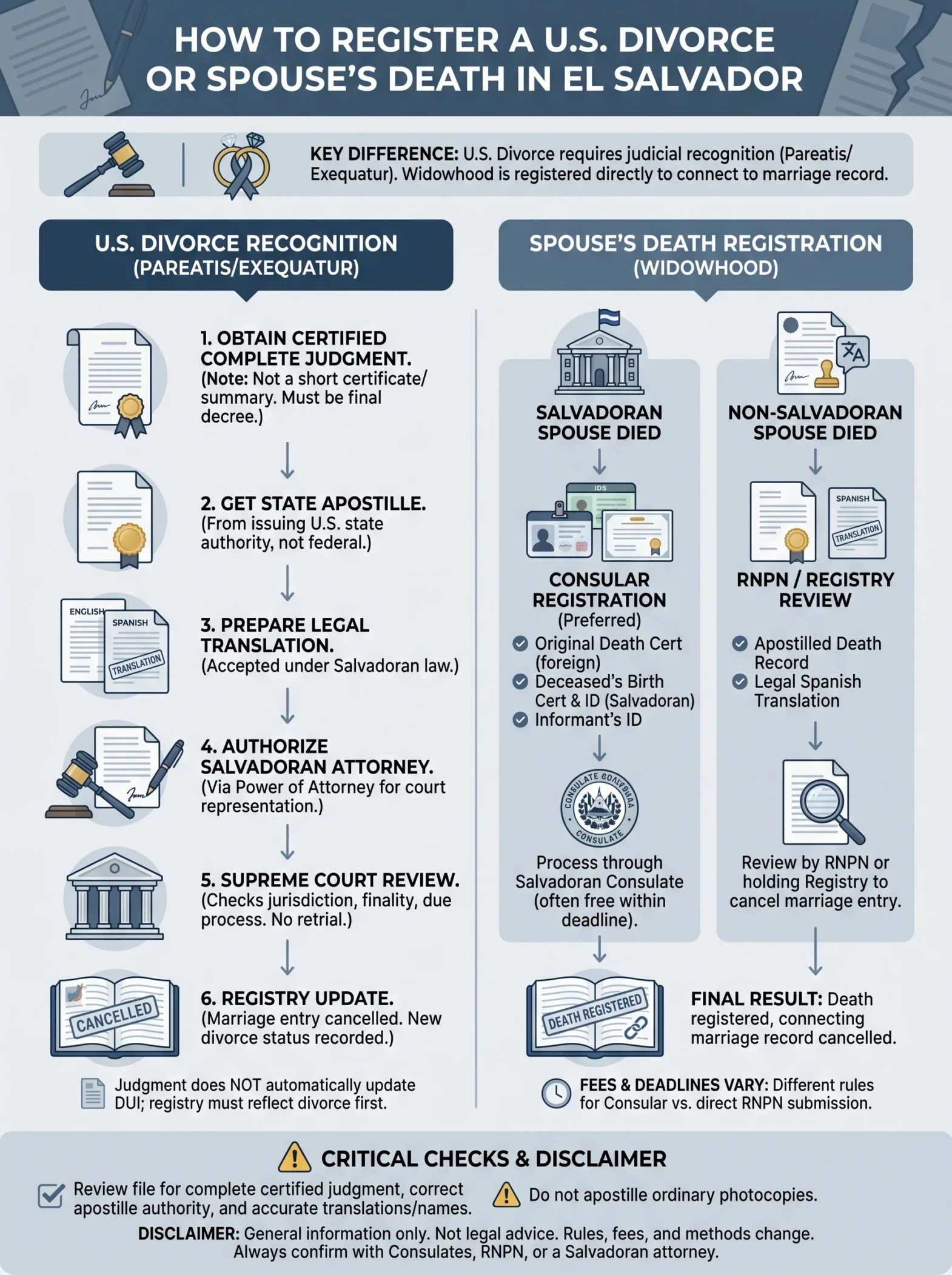
A divorce granted by a U.S. court can end the marriage under the law of the state that issued it while the Salvadoran family-status record still shows the marriage. When that U.S. divorce needs legal effect in El Salvador, the usual path is recognition of the foreign decision by the Corte Suprema de Justicia through an auto de pareatis or exequátur, followed by the registry action that reflects the divorce. The Supreme Court’s published requirements for foreign divorce cases call for the foreign judgment, Spanish translation, apostille or authentication, family records, and other supporting documents.[1]
The safest place to start is not the apostille. First identify the actual final court judgment that dissolved the marriage. A divorce certificate, online docket, settlement agreement, and final divorce judgment are different documents, and preparing the wrong one can create problems later in El Salvador.
From a U.S. divorce to a Salvadoran record:
- U.S. court judgment: establishes the divorce under the issuing jurisdiction.
- Apostille: authenticates the relevant public-document signature for use abroad.
- Pareatis/exequátur: allows the foreign decision to be recognized in El Salvador.
- Family registry action: reflects the divorce in the Salvadoran marriage record.
Important: This page is for general information only. It is not an official government page and it is not legal advice. The correct treatment of a U.S. divorce can depend on the judgment, the state that issued it, service on the former spouse, the reason for divorce, and the Salvadoran marriage record. Always confirm the latest requirements with the official agency or qualified Salvadoran counsel before taking action.
Start With the Final Court Judgment, Not Just a Divorce Certificate
U.S. states do not all use the same document title. The document may be called a Final Judgment of Divorce, Final Decree of Divorce, Judgment of Dissolution, Judgment and Decree, or something similar. What matters is that it is the court decision that actually dissolved the marriage and that it is final under the law of the issuing jurisdiction.
A separate certificate or abstract may confirm that a divorce event was recorded, but the Supreme Court’s published pareatis requirements specifically refer to the foreign sentencia. For that reason, do not assume that a certificate of divorce can replace the court judgment.
| Document | What It Usually Shows | How to Treat It for Pareatis |
|---|---|---|
| Court-certified final judgment or decree | The court’s final dissolution of the marriage | This is the core foreign decision to prepare. |
| Divorce certificate or abstract | That a divorce was recorded | Do not assume it substitutes for the judgment. |
| Marital settlement or divorce agreement | Terms agreed by the spouses | Include it when the judgment attaches, incorporates, or relies on it. |
| Docket or online case summary | Case events and status information | Useful for checking the file, but not a substitute for the certified judgment. |
Before ordering anything else, read the judgment for the divorce date, effective date, court name, case number, names of both spouses, basis for dissolution, and any statement showing that another agreement forms part of the judgment. If your state uses a separate clerk certification or other proof of finality, keep that certification with the judgment.
Apostille the Court Record Through the Correct U.S. Authority
Most U.S. divorce judgments come from state courts. The Hague Conference’s official U.S. authority information explains that public documents issued by U.S. states, the District of Columbia, and other U.S. jurisdictions are apostilled by the competent authority for that jurisdiction, generally a Secretary of State’s office. Federal documents follow a different route.[2]
That means a California divorce judgment is normally prepared through the California authentication chain, a Texas judgment through the Texas process, and so on. Some states may require an intermediate county or court certification before the apostille can be issued, so the issuing state’s instructions matter.
The apostille also needs to relate to the right certification. Apostilling a notarized photocopy is not necessarily the same as apostilling the court certification attached to the judgment.
A 2025 Supreme Court pareatis file involving a California divorce illustrates the problem. The file contained a copy certified by a foreign notary together with an apostille, but the Court required certification of the divorce judgment from the Superior Court and the apostille corresponding to the signature of the person certifying that judgment.[3]
Apostille check: The document you want authenticated is the court record you intend to present in El Salvador. Confirm who certified it, whose signature the apostille authenticates, and whether the issuing state requires another certification step before ordering translations.
Translate the Full Recognition Package Into Spanish
The Supreme Court’s published requirements state that the foreign judgment and other necessary documentation must be presented with a Spanish translation. If the foreign court added a divorce agreement or arrangement to the judgment, the CSJ also lists that agreement and its Spanish translation among the documents to present.
This is one reason to identify the complete court package before paying for a translation. Translating only the first and last pages can omit the part that identifies the legal basis for divorce, incorporates a settlement, records service, or explains when the judgment became effective.
- Keep the judgment and all court certification pages together.
- Keep the apostille physically and logically connected to the document it authenticates.
- Include an incorporated or attached divorce agreement when it forms part of the court decision.
- Have the complete package reviewed before deciding which pages can legitimately be left out of the Salvadoran filing.
Translation formalities can depend on how the Salvadoran petition is prepared. For that reason, it is useful to have the U.S. court package reviewed before commissioning the final translation rather than translating an incomplete document and paying to redo it later.
Check the Divorce Ground Before the Pareatis Petition Is Filed
The wording used to end the marriage can matter in El Salvador. Article 117 of the Salvadoran Family Code states that a foreign divorce involving people who married under Salvadoran law produces effects in El Salvador when the ground invoked is equal or similar to a ground recognized by Salvadoran law. A February 2026 Supreme Court pareatis decision applied this rule when reviewing a foreign mutual-consent divorce.[4]
Article 106 of the Family Code recognizes three grounds for divorce in El Salvador:[5]
- Mutual consent of the spouses.
- Separation for one or more consecutive years.
- Intolerable life together between the spouses.
This does not mean that every U.S. decree must use those exact Spanish concepts. U.S. states often use terminology such as irreconcilable differences, irretrievable breakdown, no-fault dissolution, or state-specific statutory language. The question is not simply whether the English phrase looks identical. The legal basis of the U.S. judgment may need to be compared with the Salvadoran grounds.
| Wording in the U.S. Record | What Needs to Be Checked |
|---|---|
| Mutual consent, agreed divorce, stipulated dissolution | Whether the actual legal basis corresponds to mutual consent under Salvadoran law. |
| Separation | The statutory basis, duration, and facts reflected in the judgment or record. |
| Irreconcilable differences or irretrievable breakdown | Whether the state-law ground is legally similar to a Salvadoran ground; the label alone should not be treated as an automatic match. |
| Cruelty or serious marital misconduct | Whether the legal and factual basis corresponds to the Salvadoran concept of intolerable life together. |
| Default no-fault divorce | Both the divorce ground and the manner in which the other spouse was served need attention. |
The wording of Article 117 specifically refers to people who married according to Salvadoran law. If the marriage was celebrated in the United States or another country and was later registered in El Salvador, do not assume that every Article 117 issue applies in exactly the same way. The marriage record and applicable law should be reviewed with the foreign judgment.
What the Supreme Court Reviews Under Article 556
Modern Supreme Court pareatis jurisprudence analyzes recognition of foreign decisions under Article 556 of the Código Procesal Civil y Mercantil. In practical terms, the Court is not simply checking whether an apostille is attached. It examines whether the foreign decision can be given legal effect within the Salvadoran legal system.
- Finality and jurisdiction: the judgment must have the required final effect in the place where it was issued and come from a court with appropriate jurisdiction.
- Notice and opportunity to defend: the person against whom the decision is invoked must have been legally served in a manner that gave that person the opportunity to defend the case.
- Authenticity: the judgment must meet the conditions required to be treated as an authentic foreign decision.
- Compatibility with Salvadoran law: recognition cannot conflict with Salvadoran constitutional principles or public order, and an obligation being enforced must be lawful in El Salvador.
- No conflicting Salvadoran case or judgment: the same matter should not already be pending or finally decided in El Salvador in a way that creates the conflict contemplated by Article 556.
Readers may encounter a confusing detail on the CSJ website: its public requirements page still reproduces provisions from the former Código de Procedimientos Civiles, including older wording concerning judgments issued in rebeldía. More recent Supreme Court jurisprudence uses Article 556 of the current civil and commercial procedural code and focuses on legal service and the real opportunity to defend. The published CSJ page remains useful for its practical document list, while the current jurisprudence is the safer reference for understanding the modern recognition test.
A U.S. Default Divorce Makes Service Records More Relevant
A U.S. judgment should not be treated as automatically unacceptable merely because one spouse did not appear. The more useful question is what happened before the default was entered.
- Was the former spouse personally served?
- Did the spouse sign a waiver, acceptance, appearance, or agreement?
- Was substituted or alternative service authorized by the U.S. court?
- Does the judgment itself contain findings about notice?
- Was service by publication used because the spouse could not be located?
If the U.S. divorce was entered by default, keep the summons, return of service, waiver, proof of publication, court order authorizing alternate service, or other available records that explain how notice was handled. They may become relevant when the Salvadoran Court considers whether the former spouse had an opportunity to defend.
The CSJ’s published checklist asks for the exact address of the other party so that notification can be carried out in the pareatis proceeding. If the current address is genuinely unknown, do not guess or provide an address that you know is no longer valid. That issue should be identified when the petition is prepared so the legally appropriate notification procedure can be determined.
Build the Divorce Recognition File Before Filing
Collecting the file as a single package makes it easier to spot a missing judgment page, mismatched apostille, missing agreement, or name variation before the petition reaches the Supreme Court.
Documents for a U.S. divorce pareatis file
- Court-certified final U.S. divorce judgment or decree.
- Apostille or other authentication required for the foreign court document.
- Spanish translation of the judgment and necessary accompanying documents.
- Original/copy and translation of a divorce agreement or arrangement when the foreign court attached it to the judgment.
- Birth records of the former spouses, as listed by the CSJ for foreign divorce cases.
- Birth records of children born within the marriage when applicable, as listed by the CSJ.
- The marriage record registered in El Salvador’s Registro del Estado Familiar.
- Reliable address information for the former spouse.
Depending on the case, it is also useful to keep service records, waivers, appearances, and documents explaining name variations. A Salvadoran record may show two surnames while the U.S. judgment uses one surname, a married surname, a different accent, or a shortened given name. Those differences should be explained through the filing rather than “corrected” by altering the U.S. court document.
If a representative in El Salvador will handle the proceeding, confirm the form and scope of any power of attorney before signing it in the United States. The authority may need to cover the judicial recognition proceeding and, when appropriate, later registry steps.
File the Auto de Pareatis With the Salvadoran Supreme Court
The CSJ’s published process places the formal pareatis request with the Secretaría General de la Corte Suprema de Justicia. Its requirements call for a formal application, the supporting originals and copies, the foreign judgment and necessary documents in Spanish, and information for notifying the other party.
- Review the U.S. judgment: confirm finality, divorce ground, court certification, incorporated agreements, and service history.
- Complete the international document preparation: obtain the correct apostille and Spanish translation.
- Prepare the pareatis petition: identify the foreign decision and explain why recognition is requested in El Salvador.
- Address notice to the former spouse: the filing must account for the other party’s procedural rights.
- Respond to any prevention or request for correction: a missing certification, apostille problem, or incomplete document can require the file to be corrected before the Court proceeds.
- Obtain the recognition decision: if the legal requirements are satisfied, the foreign decision can be recognized for its appropriate effects in El Salvador.
- Follow the family-registry step: recognition and the registry update should not be treated as the same event.
There is no useful reason to build plans around an unofficial promise that every pareatis will take a fixed number of weeks or months. A case involving straightforward mutual consent and known addresses is different from one requiring corrections, foreign notification, disputed service, or review of additional financial and family provisions.
Consulate or Supreme Court? A Salvadoran consulate in the United States may be relevant for a power of attorney or another consular document needed for the case, but a consular office does not replace the Supreme Court’s decision recognizing the U.S. divorce.
Recognizing the Divorce Does Not Automatically Enforce Every Term
A U.S. divorce judgment can contain much more than the sentence ending the marriage. It may also divide property, order spousal support, establish child support, decide custody, allocate debts, address retirement accounts, or restore a former name.
Those provisions should not all be treated as one legal question. Salvadoran jurisprudence distinguishes decisions that create or change a legal status, such as dissolution of a marriage, from provisions that order someone to perform or pay an obligation. A foreign divorce can therefore present one recognition issue for the marital bond and additional enforcement or family-law issues for other parts of the decree.
| Part of the U.S. Judgment | Main Question in El Salvador |
|---|---|
| Dissolution of the marriage | Recognition of the change in marital status. |
| Property or money judgment | Recognition may be followed by a separate enforcement question. |
| Spousal support | The payment obligation may require its own enforcement analysis. |
| Child support or custody | Additional family-law and international rules may apply. |
| Restoration or change of a name | Separate identity or registry steps may still be necessary. |
This distinction becomes particularly useful when a U.S. decree is long. A person may need the marriage itself recognized in El Salvador without assuming that every property, support, custody, or identity provision will automatically be executed there in the same proceeding.
After Recognition, Make Sure the Salvadoran Marriage Record Changes
Recognition by the Supreme Court is not the point at which the family record should be forgotten. Under the current Ley del Registro del Estado Familiar, divorce is a reason for cancellation of a marriage registration. Articles 68 and 69 provide for the corresponding judicial documentation and the cancellation to be reflected through a marginal annotation on the marriage registration.[6]
In practical terms, the file should be followed until the Salvadoran registry actually reflects the change. Do not assume that obtaining the pareatis order and placing it in your personal records automatically means every family-status record has already been updated.
It is also better not to measure completion only by whether someone gives you a separate document called a partida de divorcio. The current registry law treats divorce as a cancellation affecting the marriage registration. An updated certification of the relevant family-status record can therefore be the document that shows whether the cancellation has actually been entered.
The same law allows family-status certifications to be issued in literal or extract form. An RNPN extract certification is designed to show the record in summarized, updated form while taking modifications and cancellations into account. The law lists a US$3 fee for the extract certification and generally gives family-registry certifications a one-year validity, unless another law provides a different period. That $3 is a registry certification charge; it is not the cost of the pareatis proceeding, apostille, translation, or legal representation.
What to Verify on the Updated Record
- The marriage registration reflects the divorce-related cancellation or marginal annotation.
- The names correspond correctly to the people in the U.S. judgment and Salvadoran records.
- The judicial reference, dates, and other identifying information do not contain an obvious error.
- A current certification can be obtained showing the record after the cancellation.
If the marriage record still appears unchanged after the recognition stage has finished, the next question is no longer whether the U.S. divorce exists. It is whether the recognized decision has reached and been correctly processed by the appropriate family registry.
How the Preparation Changes in Common U.S. Divorce Scenarios
Married in El Salvador, then divorced by mutual agreement in the United States. The file should establish the final U.S. judgment, proper authentication, translation, and Salvadoran marriage record. Because the Salvadoran marriage was created under Salvadoran law, the comparison required by Article 117 deserves attention. A genuine mutual-consent basis has a direct Salvadoran counterpart, although the actual decree still needs to be reviewed rather than classified from its title alone.
Married in El Salvador, then divorced by default under a U.S. no-fault law. Two separate questions become more visible. The legal basis for the U.S. divorce must be evaluated for the required similarity, and the file should clearly show how the former spouse received notice and whether there was an opportunity to defend the U.S. proceeding.
The U.S. judgment ends the marriage and also decides property, support, or child matters. Prepare the complete judgment, but separate the questions mentally and legally. Recognition of the change from married to divorced does not by itself establish that every financial or child-related provision will be enforced in El Salvador through the same mechanism.
The divorce decree and Salvadoran marriage record use different versions of a name. Gather the records showing the connection between the names before the petition is filed. Common differences include a married surname used in the United States, omission of a second Salvadoran surname, accents, or shortened given names. The foreign judgment should remain intact; discrepancies are handled through supporting records and the legal filing, not by modifying the court document.
Official Sources
- [1] Corte Suprema de Justicia — Auto de Pareatis o Exequátur — The CSJ’s official service page lists the formal petition, foreign judgment, Spanish translation, divorce agreements, family records, address information, and apostille/authentication used for pareatis files.
- [2] HCCH — United States Competent Authorities for Apostilles — The Hague Conference identifies the competent U.S. authorities and explains that state-issued public documents are apostilled by the designated authority in the issuing jurisdiction, generally the state Secretary of State’s office.
- [3] Corte Suprema de Justicia — Pareatis 336-P-2025 — This official California-related pareatis order shows why the certification of the divorce judgment and the signature authenticated by the apostille need to be prepared correctly.
- [4] Corte Suprema de Justicia — Pareatis 49-P-2026 — This 2026 Supreme Court decision addresses foreign-divorce recognition, Article 556 CPCM, Article 117 of the Family Code, the similarity of the foreign divorce ground, and the scope of recognition of the marital bond.
- [5] El Salvador Jurisprudence — Article 106 Divorce Grounds — This official judicial source reproduces the three divorce grounds established in Article 106 of the Salvadoran Family Code.
- [6] RNPN — Ley del Registro del Estado Familiar — The official registry law covers cancellation of a marriage registration because of divorce, marginal annotations, family-status certifications, their validity, and the statutory rate for an RNPN extract certification.