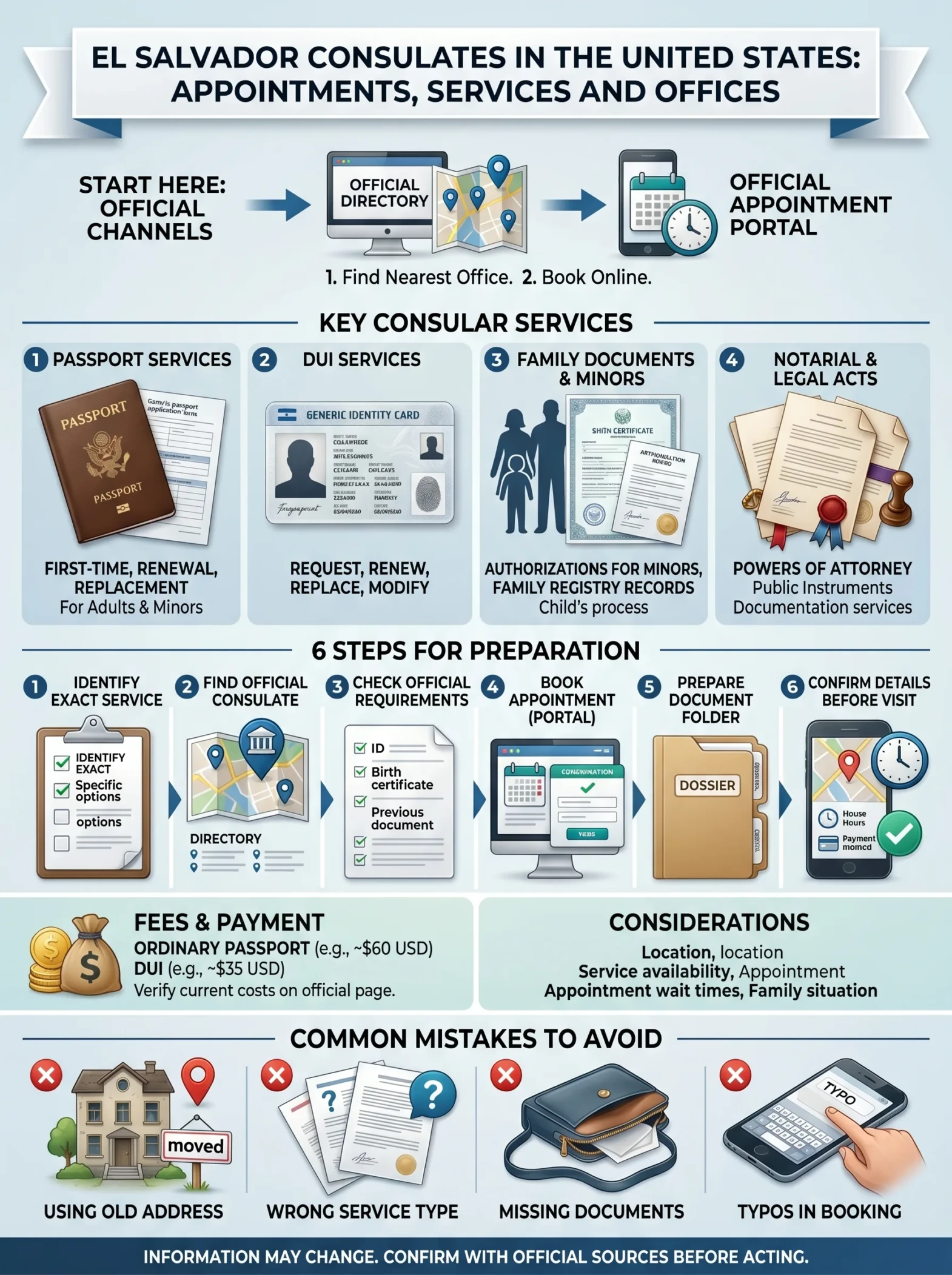
Finding the nearest Salvadoran consulate does not always tell you where to complete your specific procedure. In the United States, El Salvador’s network reached 29 consulates with the opening of the Columbus, Ohio office, and there are also dedicated DUI service centers, mobile consulates, and special service events that should not be confused with one another.[1] Before traveling, first identify the exact procedure you need and then confirm which office handles it.
If your procedure involves a DUI, check this before looking for a consulate: Salvadorans living in the United States can renew or replace a DUI entirely online. The service costs US$55 in total, including US$35 for the document and US$20 for home delivery. A first-time DUI continues to require an in-person visit to an authorized service center.[2]
Where El Salvador consulates are located in the United States
El Salvador’s Ministry of Foreign Affairs maintains an official directory of embassies, consulates, and permanent missions that can be searched by country and city.[3] The U.S. consular network includes the following offices:
Permanent DUI center
Permanent DUI center
Permanent DUI center
Permanent DUI center
Permanent DUI center
Permanent DUI center
Permanent DUI center
Permanent DUI center
Permanent DUI center
Permanent DUI center
Permanent DUI center
Permanent DUI center
Permanent DUI center
Permanent DUI center
Permanent DUI center
Permanent DUI center
Permanent DUI center
Permanent DUI center
The “Permanent DUI center” label is based on the current list published by El Salvador’s National Registry of Natural Persons (RNPN), which presently lists 18 DUI service centers in the United States.[4] If a consular office does not appear on that permanent DUI list, it does not necessarily mean DUI services are never offered there. Identity fairs, mobile service points, or special events may also be available.
Do not use this list as a substitute for checking the official address. Consulates can relocate. Before driving to an office, confirm its address and hours through the Ministry of Foreign Affairs directory or another official channel.
How to find the correct consulate without relying only on distance
An office located fewer miles from your home may not be the right choice if it does not provide the service you need or if another consulate specifically serves your area. To reduce the chance of an unnecessary trip, make the decision in this order:
- Identify the exact procedure. “I need documents” is not specific enough. Determine whether you need a first passport, passport renewal, replacement passport, DUI, birth registration, marriage registration, death registration, power of attorney, public instrument, authorization involving a minor, or another service.
- Locate the offices connected with your state or city. If more than one office is reasonably close, check any territorial or jurisdiction information published by the representation.
- Confirm that the office provides that service. The presence of a Salvadoran consulate in a city does not mean every procedure is handled there in exactly the same way.
- Determine how the service is provided. Your procedure may require an appointment, an in-person visit, attendance at a specific event, or, in some cases, an online process.
A consulate, DUI center, and mobile consulate are not the same thing
| Type | What it is | What to confirm |
|---|---|---|
| Consulate | A permanent Salvadoran representation where different consular services may be available. | Specific service, current address, hours, jurisdiction, and method of service. |
| DUI service center | A location authorized by the RNPN to handle Documento Único de Identidad procedures. | Type of DUI procedure and whether same-day printing is available. |
| Mobile consulate | Temporary consular service held in a city outside the permanent office location. | Date, location, hours, and services specifically announced for that event. |
This distinction is particularly important for the DUI. The RNPN publishes its own directory of DUI issuance centers, while the Ministry of Foreign Affairs maintains the broader directory of diplomatic and consular representations.
What services may be available through a Salvadoran consular office
The official consular service catalog includes DUI services, Salvadoran passports abroad, authorizations involving children and adolescents, Civil Registry services, migration records, public instruments, and visas.[5] When choosing an office, identifying the correct service category matters more than trying to learn every requirement at once.
| If you need | Determine this before choosing an office |
|---|---|
| Passport | Whether it is a first passport, renewal, or replacement, and whether the applicant is an adult or a minor. |
| DUI | Whether it is a first issuance, renewal, replacement, or modification. Renewal and replacement may have an online option in the United States. |
| Civil Registry service | Whether you need to register a birth, marriage, death, or complete another specific Civil Registry procedure. |
| Power of attorney, deed, or notarial act | The exact public instrument you need to execute or authorize. |
| Procedure involving a minor | Whether it involves a passport, travel authorization, or another procedure, and what participation from parents is required. |
| Salvadoran visa | Whether a consular visa is required based on the applicant’s nationality and passport type. |
For example, “I need to register my child” and “I need a passport for my child” are different procedures even though both involve a minor. The same applies to “I need a power of attorney”: the consular office needs to know what type of instrument you intend to execute before it can identify the applicable process.
Before traveling for a DUI, check whether you can complete the process from home
Since July 2026, there has been an important distinction between different DUI procedures. Salvadorans residing in the United States can complete a DUI renewal or replacement online through dui.sv/exterior using a smartphone or tablet. The published fee for this option is US$55, consisting of US$35 for the document and US$20 for home delivery.[2]
The same official announcement states that a first-time DUI must still be completed in person at one of the 18 authorized centers located at Salvadoran consular offices in the United States. Someone who only needs to renew or replace a DUI therefore should not begin by assuming a trip to a consulate is necessary.
Renewal or replacement: check the online option first.
First-time DUI: identify one of the RNPN’s in-person service centers and confirm the applicable service arrangements before traveling.
The 18 DUI service centers currently listed by the RNPN
These are the addresses currently published in the RNPN directory for DUI issuance services abroad.[4]
| City | Address published by the RNPN |
|---|---|
| Los Angeles, CA | 3250 Wilshire Blvd, Suite 550, Los Angeles, CA 90010 |
| San Francisco, CA | 500 Golden Gate Ave, San Francisco, CA 94102 |
| Las Vegas, NV | 765 N. Nellis Blvd, Suite C-5, Las Vegas, NV 89110 |
| Houston, TX | 8300 Bissonnet St, Ste. 400, Houston, TX 77074 |
| Dallas, TX | 7610 N Stemmons Fwy #400, Dallas, TX 75247 |
| Plainview, NY | 111 Express St, Plainview, NY 11803 |
| New York, NY | 14 W 37th St, New York, NY 10018 |
| Elizabeth, NJ | 40 Parker Road, Suite 100, Elizabeth, NJ 07208 |
| Silver Spring, MD | 926 Philadelphia Ave, Silver Spring, MD 20910 |
| Woodbridge, VA | 14572 Potomac Mills Road, Woodbridge, VA 22192 |
| Charlotte, NC | 1520 West Boulevard Suite, Charlotte, NC 28208 |
| Duluth, GA | 3550 Corporate Way, Suite A, Duluth, GA 30096 |
| Boston, MA | 46 Bennington St, Boston, MA 02128 |
| Chicago, IL | 8605 W Bryn Mawr Ave, Suite 310, Chicago, IL 60631 |
| Aurora, CO | 1450 S Havana St, Suite 100, Aurora, CO 80012 |
| Doral, FL | 8550 NW 33rd St 100, Doral, FL 33122 |
| Seattle, WA | The Broderick Building, 615 2nd Ave #50, Seattle, WA 98104 |
| Springdale, AR | 3875 W Sunset Ave, Springdale, AR 72762 |
Five cities now print the DUI on the same day
The RNPN confirmed that in situ DUI printing is available in Chicago, Illinois; Aurora, Colorado; Charlotte, North Carolina; Springdale, Arkansas; and Doral, Florida.[6] When the in-person procedure can be completed normally, the document is printed at the service location and may be delivered the same day.
Illinois
Colorado
North Carolina
Arkansas
Florida
The RNPN also stated that its overseas network has 24 service centers and that 18 are expected to have in situ printing by the end of 2026.[6] Same-day availability may therefore expand, so check the specific service available at a location before a future visit.
Old names and addresses that may still appear in searches
One reason not to rely exclusively on Google Maps, private directories, or older saved posts is that some Salvadoran representations have changed locations or even moved to a different city within the same metropolitan area.
The former Laredo consulate now operates in San Antonio
The Consulate General of El Salvador in San Antonio previously operated in Laredo, Texas. The Ministry of Foreign Affairs inaugurated the San Antonio facilities on July 6, 2024 and described the change as a relocation intended to bring consular services closer to the Salvadoran community in the area. Laredo should therefore not be treated as a separate current consular office.[11]
The Long Island consulate now operates from Plainview
The Consulate General long identified as the Long Island office began operating on March 31, 2025, at 111 Express St, Plainview, NY 11803.[7] An older search for “El Salvador Consulate in Long Island” may therefore display references that no longer match the current address.
The office associated with Atlanta is located in Duluth
The representation that previously operated in Atlanta relocated to Duluth in 2022. The Ministry of Foreign Affairs published its address as 3550 Corporate Way, Suite A, Duluth, GA 30096, which is also the address currently shown in the RNPN DUI service center directory.[8]
Columbus is a newer addition to the U.S. consular network
The Columbus office is located at 200 E Campus View Blvd., Ste. 240, Columbus, OH 43235. The Ministry of Foreign Affairs reported that its opening increased El Salvador’s U.S. network to 29 consulates and stated that the office provides coverage particularly for Salvadorans in Ohio and Michigan.[1]
When a mobile consulate may be useful
If the nearest permanent office is several hours away, a mobile consulate event may reduce the need for a long trip. The Ministry of Foreign Affairs uses these events to bring selected services to cities without a permanent Salvadoran consular office. Its appointment portal also provides information about mobile consulates and special service events.[9]
The word “mobile” matters: the event address is valid for that activity and for the announced dates. It should not be saved as though it were a new permanent consulate.
One event may provide only passport services, while another may include DUI services, Civil Registry procedures, or other transactions. Before attending, check which services were specifically announced. An event described as a “mobile consulate” does not automatically provide every consular service.
Not every consular procedure is handled the same way
The Ministry of Foreign Affairs appointment portal includes scheduling for passport procedures, public deeds, notarial acts, Civil Registry matters, documentation, visas and immigration-related consular services, and DUI procedures.[9] This does not mean every service, office, or special event always uses the same method of service.
First identify the correct representation and confirm that it handles your procedure. Then determine whether that service requires an appointment, follows the office’s own attendance instructions, or is being provided through a special event. For DUI renewals and replacements in the United States, the online option may eliminate the need for a consular visit entirely.
Four details that should match before you leave home
This check is especially useful if you plan to cross state lines or drive several hours. Having the correct address does not solve the problem if that office cannot provide the service you need on the day you visit.
What to do if you do not know which consulate handles your case
The Ministry of Foreign Affairs publishes the toll-free Virtual Consulate number 1-888-301-1130 for calls from the United States and Canada, as well as WhatsApp at +503 7070-1071.[10]
To make it easier to identify the correct office, provide specific information:
- the state and city where you live;
- the exact name of the procedure;
- whether the procedure concerns an adult or a minor when that affects the process;
- and, for a DUI or passport, whether it is a first issuance, renewal, or replacement.
A question such as “I live in Michigan and need to renew my Salvadoran passport. Which office handles my area, and do I need an appointment?” is more useful for identifying the correct office than simply asking which consulate is closest.
What a Salvadoran consulate does not decide in the United States
An El Salvador consulate can assist with Salvadoran documents and consular services, but it does not replace U.S. immigration authorities or U.S. courts. Matters such as asylum, TPS, permanent residence, work permits, removal proceedings, or U.S. citizenship are decided by the appropriate U.S. authorities.
A document issued or processed through a Salvadoran consulate may be used as part of one of those processes, but the consulate does not determine a person’s U.S. immigration status. For an individual legal situation, use information from the responsible government agency or seek qualified legal advice.
Official Sources
- [1] Ministry of Foreign Affairs: Opening of the Consulate General of El Salvador in Columbus, Ohio — Confirms that the Columbus office increased the U.S. network to 29 consulates and provides the office address and information about its coverage for Ohio and Michigan.
- [2] Ministry of Foreign Affairs: Online DUI Renewal and Replacement for Salvadorans in the United States — Confirms the online process for DUI renewal and replacement, the total US$55 cost, and that first-time issuance remains an in-person procedure at authorized centers.
- [3] Embassies, Consulates and Permanent Missions of the Republic of El Salvador — The Ministry of Foreign Affairs directory for locating Salvadoran representations by region, country, and city.
- [4] RNPN Service Centers for DUI Issuance Abroad — Lists the 18 DUI service centers currently published for the United States and their addresses.
- [5] Services Provided by El Salvador Embassies and Consulates Abroad — Lists official consular service categories including DUI, passports, Civil Registry services, authorizations involving minors, public instruments, and visas.
- [6] RNPN: Same-Day In-Situ DUI Printing in Five U.S. Cities — Confirms in-situ DUI printing in Chicago, Aurora, Charlotte, Springdale, and Doral and describes the planned expansion of immediate printing services.
- [7] El Salvador Consulate in Long Island Relocates to Plainview — Confirms that operations in Plainview began March 31, 2025, and provides the new address.
- [8] Consulate General of El Salvador in Atlanta Announces Relocation to Duluth — Documents the relocation of the representation to Duluth and provides the office address.
- [9] Appointment Portal — Ministry of Foreign Affairs of El Salvador — Identifies services available through the appointment system and notes that the portal also provides information about mobile consulates and special service events.
- [10] Contact — Ministry of Foreign Affairs of El Salvador — Publishes the official Virtual Consulate contact channels for the United States and Canada, including WhatsApp.
- [11] Ministry of Foreign Affairs: Consulate General of El Salvador Opens in San Antonio, Texas — Confirms that the Consulate General in San Antonio previously operated in Laredo and that the San Antonio facilities were inaugurated on July 6, 2024.