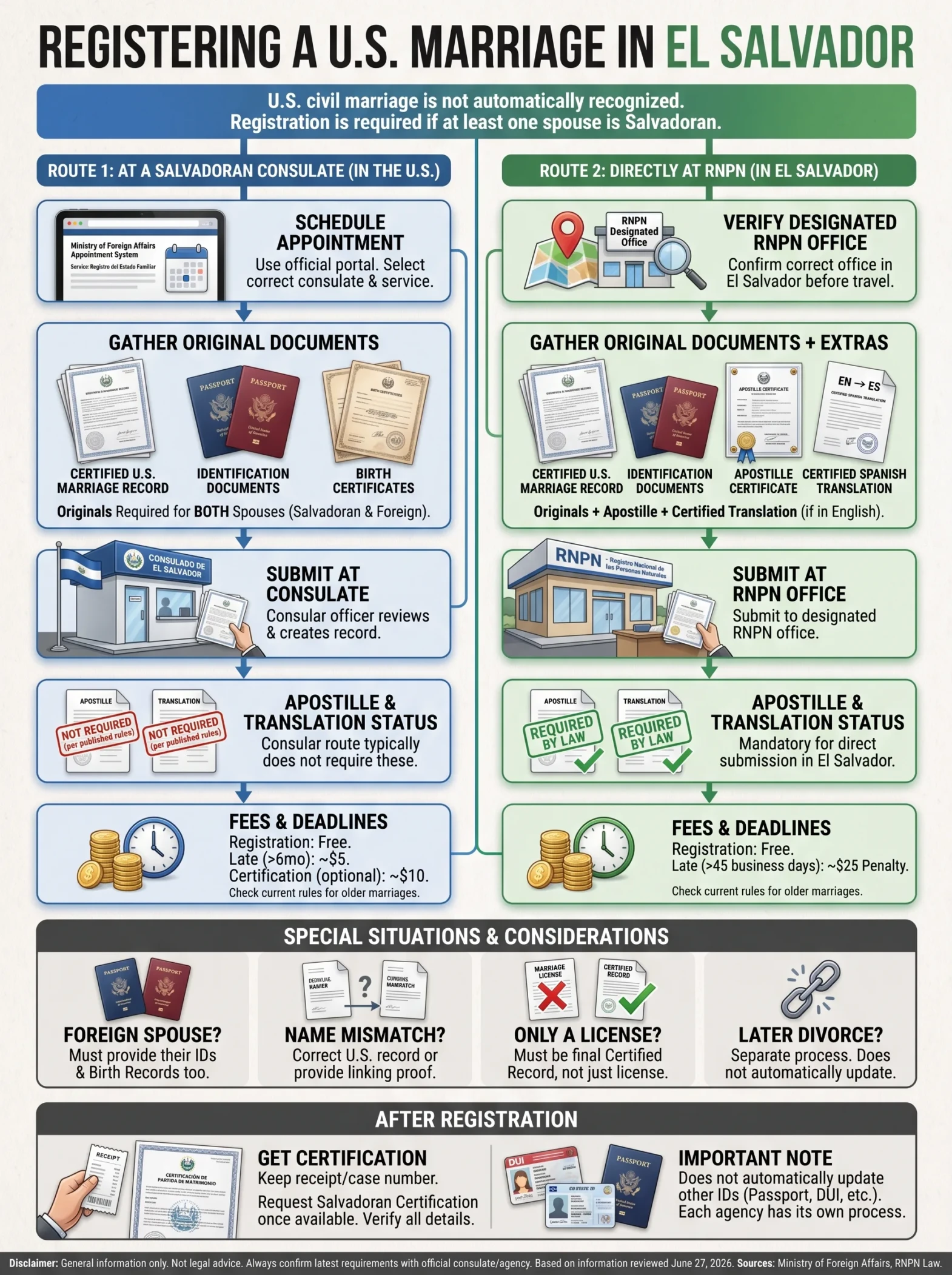
A civil marriage celebrated in the United States does not automatically appear in El Salvador’s Family Status Registry. If one or both spouses need the marriage to be reflected in Salvadoran records, the event that occurred abroad must be registered. The process may be handled from the United States through a Salvadoran diplomatic or consular office, and marriages that were not registered through a consulate may also be submitted for registration through El Salvador’s National Registry of Natural Persons (RNPN).[1]
The distinction between these two routes matters because they do not have exactly the same documentary requirements, deadlines, or fees. In particular, apostille and translation requirements that apply to foreign documents submitted to the RNPN should not automatically be assumed to apply in the same way to a marriage registered directly through a Salvadoran consulate.
First determine where you will register the marriage
For someone living in the United States, there are two main situations.
If you will complete the process from the United States
You may request registration through the Salvadoran diplomatic or consular office corresponding to the place where the marriage occurred or through the office closest to your residence. El Salvador’s Ministry of Foreign Affairs publishes this route specifically for births, marriages, and deaths involving Salvadorans that occurred abroad.
If the documents will be submitted in El Salvador
The Family Status Registry Law gives the RNPN authority over marriages of Salvadoran nationals celebrated abroad that were not registered through a consulate. The RNPN has also published a specific service for registering legal events and acts that occurred outside El Salvador.[2][3]
The Ministry of Foreign Affairs also states that people who are already in El Salvador may handle foreign family-status registrations through its regional offices, while the current law and the RNPN’s published service assign registration of unregistered foreign events to the RNPN. If you plan to submit the file inside El Salvador, confirm which receiving office applies to your case before going, but prepare the foreign documents according to the apostille or authentication and translation requirements applicable to the RNPN route.
Do not mix the two routes: a requirement that applies when a foreign document is submitted directly for registration through the RNPN does not necessarily appear in the requirements published for a marriage registered through a Salvadoran consulate.
Which U.S. marriage document you need
Before paying for apostilles, translations, or appointments, check which document you actually received after getting married. In the United States, a marriage license and a marriage certificate are not the same thing.
USAGov defines a marriage license as the legal authorization to marry and a marriage certificate as the document that proves the marriage occurred. To obtain a certified copy of a U.S. marriage record, federal guidance directs applicants to the vital records office of the state where the marriage took place.[4]
| Document | What it shows | What to keep in mind |
|---|---|---|
| Marriage license | Authorization to get married. | It should not be confused with final proof that the marriage was completed and officially recorded. |
| Marriage certificate | Proof that the marriage occurred. | This is the record used to establish the marriage before Salvadoran authorities. |
| Certified copy | An officially certified copy of the marriage record. | This is the type of copy that should be requested from the authority that maintains the official record. |
| Decorative or keepsake certificate | May document the ceremony for personal purposes. | It should not be treated as a substitute for a certified civil record issued by the authority responsible for the marriage registration. |
The relevant state is the state where the marriage occurred and was recorded, not necessarily the state where the couple currently lives. Someone who married in Nevada and now lives in California should obtain the marriage record from Nevada.
What to check on the certificate before starting
A certified copy should clearly identify the marriage being submitted for registration. Check the names of both spouses, the date of marriage, the place where it occurred, and the authority that issued or maintains the record.
It is also useful to compare this information with the birth certificates and Salvadoran identification documents that will be submitted. U.S. records often handle surnames differently from Salvadoran records: a second surname may be missing, an accent mark may be omitted, or a married surname may appear. A formatting difference is not the same as an actual error, but a significant discrepancy may need to be clarified before the Salvadoran record can be created correctly.
How to register the marriage through a Salvadoran consulate
El Salvador’s Ministry of Foreign Affairs allows marriages involving Salvadorans that occurred abroad to be registered through the diplomatic or consular office corresponding to the place where the event occurred or through the office closest to the interested person’s residence.[1]
Documents published for consular marriage registration
For marriage registration, the Ministry of Foreign Affairs publishes the following requirements:
- original foreign marriage record certification;
- original identification documents for both spouses;
- original birth certificate certifications for both spouses.
The published requirement expressly refers to both spouses. Therefore, if a Salvadoran citizen is married to a U.S. citizen or someone of another nationality, do not assume that the foreign spouse’s identification and birth documents are unnecessary.
If the person reporting and requesting registration of the marriage is not related to the spouses, the Ministry of Foreign Affairs requires that person to prove legal, contractual, or judicial representation and present a valid original identification document.[1]
Does the consulate require an apostille and translation?
The Ministry of Foreign Affairs’ public list for consular marriage registration includes the original foreign marriage certification, identification documents, and birth records, but it does not separately list an apostille or translation as a general requirement within that published checklist.[1]
This distinction matters because the Family Status Registry Law does require authentication or apostille and Spanish translation, when applicable, for foreign documents submitted under the RNPN registration route. These are different procedures. If the marriage certificate you plan to take to the consulate is only in English or has an unusual format, confirm the document requirements with the specific consular office before paying for an additional formality that does not appear in the general published list.
When the marriage is submitted for registration in El Salvador
The Family Status Registry Law specifically addresses marriages of Salvadoran nationals celebrated outside El Salvador that were not registered through the corresponding consulate. Article 92 assigns those registrations to the RNPN.[2]
The RNPN has also added “Registrations of legal events and acts abroad” to its public services and published the service on June 25, 2026. The RNPN’s informational material expressly lists marriage among the events that can be registered.[3][5]
Apostille and translation for this route
For supporting documents issued abroad and presented for this type of registration, the law states that they must be properly authenticated or apostilled, as applicable. If they are written in a language other than Spanish, they must be translated into Spanish by a competent official.[2]
The RNPN information sheet for this service states the same two requirements: “Authentication or Apostille” and “Official Translation” when the document is in another language.[5]
If your marriage certificate is in English and will be submitted directly for registration in El Salvador:
prepare the document for international use, including the applicable apostille, and obtain the Spanish translation required for the RNPN process.
Where to obtain an apostille for a U.S. marriage certificate
A marriage certificate issued by a U.S. state is a state document, not a federal document. USAGov states that state-issued vital records that require an apostille generally obtain it through the Secretary of State of the state that issued the document. Federal documents follow a different authentication process through the U.S. Department of State.[6]
For example, a marriage certificate issued in Texas follows the Texas apostille process, while one issued in California follows California’s process. Where the spouses currently live does not change which state is responsible for authenticating the signature or seal on the marriage record.
Do not automatically send a state-issued marriage certificate to the U.S. Department of State under the assumption that all documents used abroad receive apostilles there. The correct authority depends on which government entity issued the document.
You may not have to travel personally from the United States
For the route governed by Article 92, foreign documents may be submitted for registration by any interested person at offices designated by the RNPN, provided the documents comply with the applicable formalities.[2]
This should not be confused with the consular requirement that applies when an unrelated person acts as the informant, for whom the Ministry of Foreign Affairs publishes a specific representation requirement. The rules depend on which registration route is being used.
Deadlines and charges differ depending on the route
Two official rules may appear inconsistent when read without context: the Ministry of Foreign Affairs publishes a six-month period in connection with its consular fee schedule, while the Family Status Registry Law establishes a 45-business-day period for certain marriages celebrated abroad that were not registered through a consulate. The rules apply to different procedures.
| Situation | Published rule |
|---|---|
| Consular registration within the applicable period | The Ministry of Foreign Affairs lists the registration as exempt from payment. |
| Consular registration more than six months after the event | The Ministry of Foreign Affairs publishes a US$5 fine. |
| Consular Family Status Registration Certification | The Ministry of Foreign Affairs publishes a US$10 fee. |
| Marriage abroad not registered at a consulate and subject to RNPN registration | Article 92 establishes a maximum of 45 business days following the date on which the event or legal act was evidenced through the corresponding document. |
| Expiration of the Article 92 period | The law establishes a US$25 fine for obligated persons or interested parties. |
The wording of the 45-day rule deserves attention: the law does not simply say “45 days from the wedding.” It refers to 45 business days following the date on which the event or act was evidenced through the corresponding document.[2]
The same law establishes gratuity as a principle for creating Family Status Registry entries, although certifications, records, and other documents may be subject to fees established under the applicable laws.[2]
What the five-business-day consular rule actually means
Article 92 also states that the consular official has five business days to enter the events and legal acts covered by the preceding article into the RNPN information system.[2]
This deadline is an obligation placed on the consular official within the registration system. It should not automatically be interpreted as a guarantee that the applicant will receive a completed certification exactly five business days after appearing at the consulate, since document intake, review, registration, and issuance of a certification are separate steps.
If the U.S. certificate does not show a married surname
U.S. and Salvadoran marriage records do not always contain the same fields. The Family Status Registry Law specifically addresses situations in which the document used to formalize the marriage does not state the woman’s choice of married surname.
Article 66 provides that this omission is not, by itself, grounds for refusing the registration. The corresponding notation is entered in the observations section of the record and, for later identification procedures, the person’s maiden surnames are used until the applicable correction or adjustment is completed.[2]
This is different from a marriage certificate that contains an actual error in one spouse’s name. If the U.S. record contains an incorrect name, wrong date, or another material error, it may be necessary to correct the record with the U.S. authority that issued or maintains it rather than attempting to reproduce the error in the Salvadoran registry.
What happens if the U.S. record does not state a marital property regime
A Salvadoran marriage registration includes, among other information, the property regime agreed to by the spouses. The same Article 66 also explains what happens when the document submitted does not contain that information: the supplementary legal property regime established under the Family Code is entered in the record.[2]
The absence of a marital property field on a U.S. marriage certificate therefore should not automatically be interpreted as making the document invalid for Salvadoran registration purposes.
What information becomes part of the Salvadoran marriage record
The Family Status Registry Law provides that a marriage registration should contain information such as each spouse’s name, age, previous family status, nationality, profession or occupation, residence, place of birth, and identity document. It also covers parental information, the place and date of the marriage, surname choice, and marital property regime.[2]
For that reason, once the registration is completed, review the resulting Salvadoran marriage certification and check the applicable information, including:
- the full names and surnames of both spouses;
- the date and place of marriage;
- nationalities;
- identification information;
- previous family status;
- information concerning the surname used after marriage;
- the property regime entered in the record.
How the marriage relates to Salvadoran birth records
The law also provides for family-status information to be updated in birth registrations. When a marriage is not registered in the same municipality where the spouses’ birth records are located, the corresponding marginal annotations are to be updated through the Centralized Family Status Registry System.[2]
This helps explain why registering a foreign marriage is not simply a matter of storing a copy of the U.S. certificate. The purpose is to incorporate the marriage into El Salvador’s family-status registration system and connect it with the appropriate personal records.
What registering the marriage in El Salvador does not automatically change
Registering the marriage in El Salvador does not by itself update records maintained by U.S. government agencies. If someone adopted a new surname after marriage, changes with Social Security, a U.S. passport, a driver’s license, or a state ID follow the procedures of the agency responsible for each record. USAGov treats those updates as separate processes and notes that certified documents may be needed as proof of a legal name change.[7]
Likewise, if information on a Salvadoran DUI or another Salvadoran identity document later needs to be changed, the registered marriage may serve as supporting evidence, but registering the marriage and updating an identity document remain separate procedures.
Situations to resolve before submitting the file
You only have the marriage license
First obtain proof that the marriage was completed and officially recorded. A marriage license shows authorization to marry; it does not serve the same purpose as the marriage certificate.[4]
You only have a photocopy or keepsake certificate
Obtain a certified copy of the official record. USAGov directs requests for U.S. marriage certificates to the vital records office of the state where the marriage occurred.[4]
The names do not match exactly
First determine whether the difference is simply the result of U.S. records using only one surname, omitting accent marks, or showing a married surname. If the difference is an actual error in the U.S. record, the correction should be addressed with the authority that maintains that record before using it as the basis for the Salvadoran registration.
One spouse is not Salvadoran
Do not prepare the file using only the Salvadoran spouse’s documents. The official Ministry of Foreign Affairs list for consular marriage registration requires identification and birth certificate documentation for both spouses.[1]
Before submitting the file: make sure you have the correct civil marriage record, that the names can be matched to the identification documents and birth records being presented, and that you are following the documentary requirements for the route you will actually use: consular registration or registration of the foreign document through the RNPN.
This information is general in nature and is based on official sources concerning family-status registration procedures. It does not replace a decision by the RNPN or the Ministry of Foreign Affairs, or legal advice for cases involving record errors, foreign court judgments, or other individual circumstances.
Official Sources
- [1] Ministry of Foreign Affairs of El Salvador — Family Status Registry — Explains the routes for registering marriages that occurred abroad, the documents required for consular registration, and the published consular fees.
- [2] RNPN — Family Status Registry Law — Governs the contents of marriage registrations, surnames, marital property regimes, consular registrations, and RNPN registration of marriages celebrated abroad.
- [3] RNPN — Registrations of legal events and acts abroad — Official RNPN service page covering the registration of legal events and acts that occurred outside El Salvador.
- [4] USAGov — How to get a copy of a marriage certificate or a marriage license — Explains the difference between a marriage license and marriage certificate and where to request a certified copy of a U.S. marriage record.
- [5] RNPN — Information sheet for registrations from abroad — Lists marriage among registrable events and identifies authentication or apostille and official translation requirements when applicable.
- [6] USAGov — Authenticate an official document for use outside the U.S. — Explains which authority issues an apostille for state-issued U.S. vital records and distinguishes state documents from federal documents.
- [7] USAGov — How to change your name and what government agencies to notify — Confirms that name updates with U.S. agencies are separate procedures and may require certified documents as evidence.