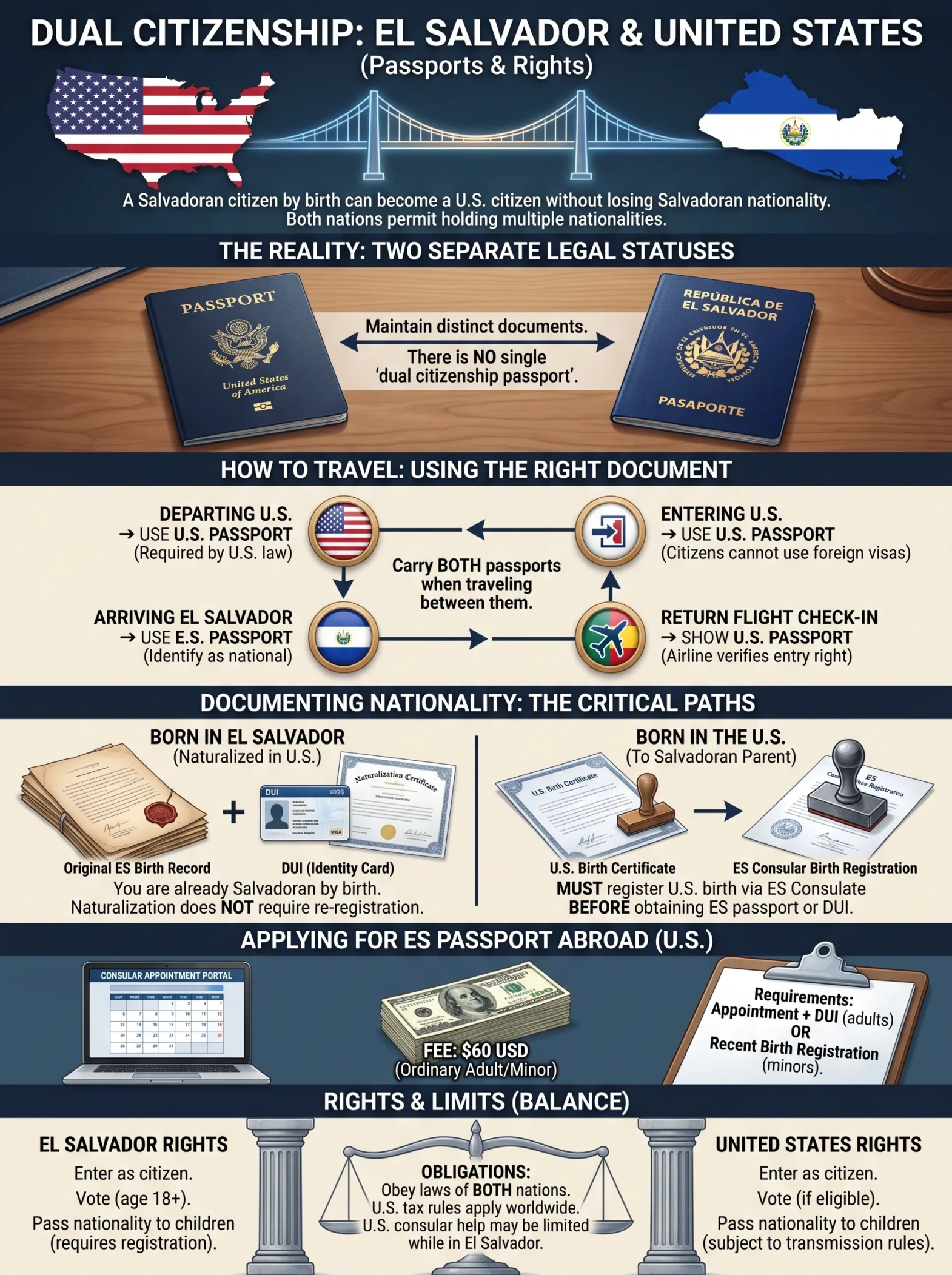
A Salvadoran citizen by birth can become a U.S. citizen without automatically losing Salvadoran nationality. El Salvador’s Constitution gives Salvadorans by birth the right to hold dual or multiple nationality. The United States also permits dual nationality and does not require a citizen to choose only one.[1]
In practical terms, each nationality keeps its own documents, rights, and obligations. You may hold a Salvadoran passport and a U.S. passport; there is no separate “dual-nationality passport.” A U.S. citizen must use a U.S. passport to enter and leave the United States.[2]
The central rule: Becoming a U.S. citizen does not, by itself, cancel the Salvadoran nationality of a Salvadoran citizen by birth. Passports document each citizenship, but they do not replace a birth registration, naturalization record, or other proof showing how the nationality was acquired.
| Situation | What It Means | What to Keep in Mind |
|---|---|---|
| Born in El Salvador and naturalized in the United States | You may retain Salvadoran nationality by birth together with U.S. citizenship. | Each country continues to issue and recognize its own citizenship and identity documents. |
| Obtained Salvadoran nationality through naturalization | The constitutional rules are not the same as those covering Salvadorans by birth. | Request an individual review of your naturalization decision before assuming that the same dual-nationality protection applies. |
| Married to a Salvadoran or U.S. citizen | Marriage alone does not automatically give a spouse the other country’s citizenship. | The spouse must qualify independently under the nationality or naturalization rules that apply. |
Important: This page is for general information only. It is not an official government page and it does not replace legal advice. Always confirm the latest requirements with the official consulate or agency before taking action, especially if your Salvadoran nationality was obtained through naturalization, recovery, or a previous renunciation.
How to Use Two Passports When Traveling
Nationality establishes your legal connection to each country. A passport proves that connection during international travel. Holding both documents does not mean you may freely choose which passport to present at every checkpoint.
| Part of the Trip | Primary Document | Reason |
|---|---|---|
| Leaving the United States | U.S. passport | U.S. citizens are required to enter and leave the country using a U.S. passport. |
| Arriving in El Salvador | Valid Salvadoran passport, if available | It allows you to identify yourself to Salvadoran immigration authorities as a Salvadoran national. |
| Checking in for the return flight | U.S. passport | The airline must verify that you have the right to enter the United States without a visa. |
| Entering the United States | U.S. passport | A U.S. citizen cannot use a visa in a foreign passport to enter as a foreign visitor. |
An airline may ask to see both documents. For example, it may review the Salvadoran passport for the destination and the U.S. passport to verify your right to return. Showing both documents does not mean that one nationality has replaced the other.
If your surnames appear differently in the two passports, book the ticket under the name shown in the passport that will be used for the main immigration inspection. Carry the document explaining the difference, such as a marriage certificate or legal name-change order. A name difference does not cancel either citizenship, but it can lead to additional review.
How to Document Salvadoran Nationality
If You Were Born in El Salvador and Later Became a U.S. Citizen
You are already Salvadoran by birth. Becoming a naturalized U.S. citizen does not require you to register your birth again or apply for Salvadoran nationality as though it were new.
The documents commonly used to prove and exercise that nationality are:
- A certified Salvadoran birth record.
- A Documento Único de Identidad, or DUI, when applicable.
- A valid Salvadoran passport.
- A U.S. naturalization certificate or U.S. passport proving U.S. citizenship.
An expired Salvadoran DUI or passport does not erase your nationality. It may, however, prevent you from using that document for a transaction or for travel until it is renewed.
If Your Question Is About a Child Born in the United States
A child born in the United States to a Salvadoran mother or father may have Salvadoran nationality by birth under El Salvador’s constitutional rules. The first registration of that U.S. birth is a separate process from the dual-nationality issues covered on this page.
For the registration service, required documents, consular charges, and the steps used to create the Salvadoran birth record, see Salvadoran Citizenship for Children Born in the United States: Registration and Requirements.
If You Became Salvadoran Through Naturalization
The constitutional article guaranteeing dual or multiple nationality specifically covers Salvadorans by birth. El Salvador’s Constitution addresses naturalized citizens separately and includes distinct rules concerning the loss of naturalized nationality.
Before naturalizing in the United States or making a formal declaration concerning nationality, obtain a copy of your Salvadoran naturalization decision and request an individual review from El Salvador’s immigration authority. The rule used for someone born in El Salvador or born abroad to a Salvadoran parent should not automatically be applied to this situation.
Salvadoran Passports and Dual Nationality
A Salvadoran passport is one way to document and use Salvadoran nationality for travel, while a U.S. passport performs that role for U.S. citizenship. Holding both passports does not create or strengthen dual nationality by itself. Each passport is issued under the rules of the country that grants it.
If you need to apply for your first Salvadoran passport, renew an existing passport, replace a lost or damaged passport, prepare a minor’s application, review fees, or book the related consular service, see Salvadoran Passport in the United States: Requirements, Appointments and Renewal. Those passport procedures are separate from determining whether you may hold both Salvadoran and U.S. nationality.
Rights Connected to Each Citizenship
Dual nationality does not create a separate set of rights. Each country treats you as its citizen when you are under its jurisdiction and meet the conditions required to exercise a particular right.
| Right or Ability | In El Salvador | In the United States |
|---|---|---|
| Living and entering as a citizen | You may identify yourself as Salvadoran using your Salvadoran documents. | You enter as a U.S. citizen with a U.S. passport and do not apply for a U.S. visa. |
| Using a national passport | A Salvadoran passport can identify you as a Salvadoran national for travel and other situations where that document is accepted. | A U.S. passport documents U.S. citizenship for international travel and entry into the United States. |
| Voting | Salvadorans age 18 or older are citizens with voting rights, subject to the applicable electoral registration and documentation rules. | Dual citizens may vote when they meet the applicable age, residency, and state registration requirements.[3] |
A relative does not automatically receive both nationalities because another family member holds them. Each child, spouse, or parent needs an independent legal basis and documents issued in that person’s name.
Obligations and Limits of Dual Nationality
A dual national must obey the laws of both countries. Salvadoran nationality does not remove responsibilities connected to U.S. citizenship, including federal tax rules that may apply to income or financial accounts outside the United States.
U.S. consular assistance may also be limited while you are in the country of your other nationality. When a Salvadoran-U.S. citizen is in El Salvador, Salvadoran authorities may treat that person primarily as a Salvadoran national. This does not cancel U.S. citizenship, but it can restrict what the U.S. Embassy is able to do in certain situations.
Using a Salvadoran passport for a Salvadoran transaction or for travel outside the United States does not amount to renouncing U.S. citizenship. Renunciation is a separate formal act. Allowing a passport to expire, deciding not to renew it, or using the other country’s document does not by itself end a nationality.
How Dual Nationality Affects Different Situations
| Your Situation | Nationality Position | What to Address Separately |
|---|---|---|
| Born in El Salvador and later became a U.S. citizen | U.S. naturalization does not by itself cancel Salvadoran nationality by birth. | Keep the Salvadoran and U.S. documents you need for travel, identity, or other transactions current. |
| Born in the United States to a Salvadoran parent | Salvadoran nationality by birth may apply under the constitutional rule for children born abroad to a Salvadoran parent. | The initial Salvadoran birth registration is handled through the separate child-citizenship process. |
| Names differ between Salvadoran and U.S. records | A difference in names does not by itself end either nationality. | Identify which civil or identity record needs correction before relying on a new document to resolve the mismatch. |
| Naturalized Salvadoran citizen | Different constitutional provisions apply from those covering Salvadorans by birth. | Obtain an individual review of the Salvadoran naturalization record before relying on the rules for nationality by birth. |
When several members of one family have Salvadoran and U.S. documents, keep each person’s records separate. One family member’s dual nationality does not establish another person’s citizenship, and one person’s passport or birth record cannot substitute for documents issued in another person’s name.
Official Sources
- [1] Constitution of the Republic of El Salvador — Articles 71, 72, 90, and 91 identify Salvadorans by birth, recognize dual or multiple nationality, and establish citizens’ political rights. This is the constitutional text published by El Salvador’s Legislative Assembly.
- [2] Dual Nationality — U.S. Department of State — This page explains that the United States permits dual nationality and requires U.S. citizens to use a U.S. passport when entering and leaving the country. It is the official federal travel guidance for U.S. citizens.
- [3] Who Can and Cannot Vote — USAGov — This official U.S. government page confirms that dual citizens may vote when they satisfy the applicable citizenship, age, residency, and registration requirements.