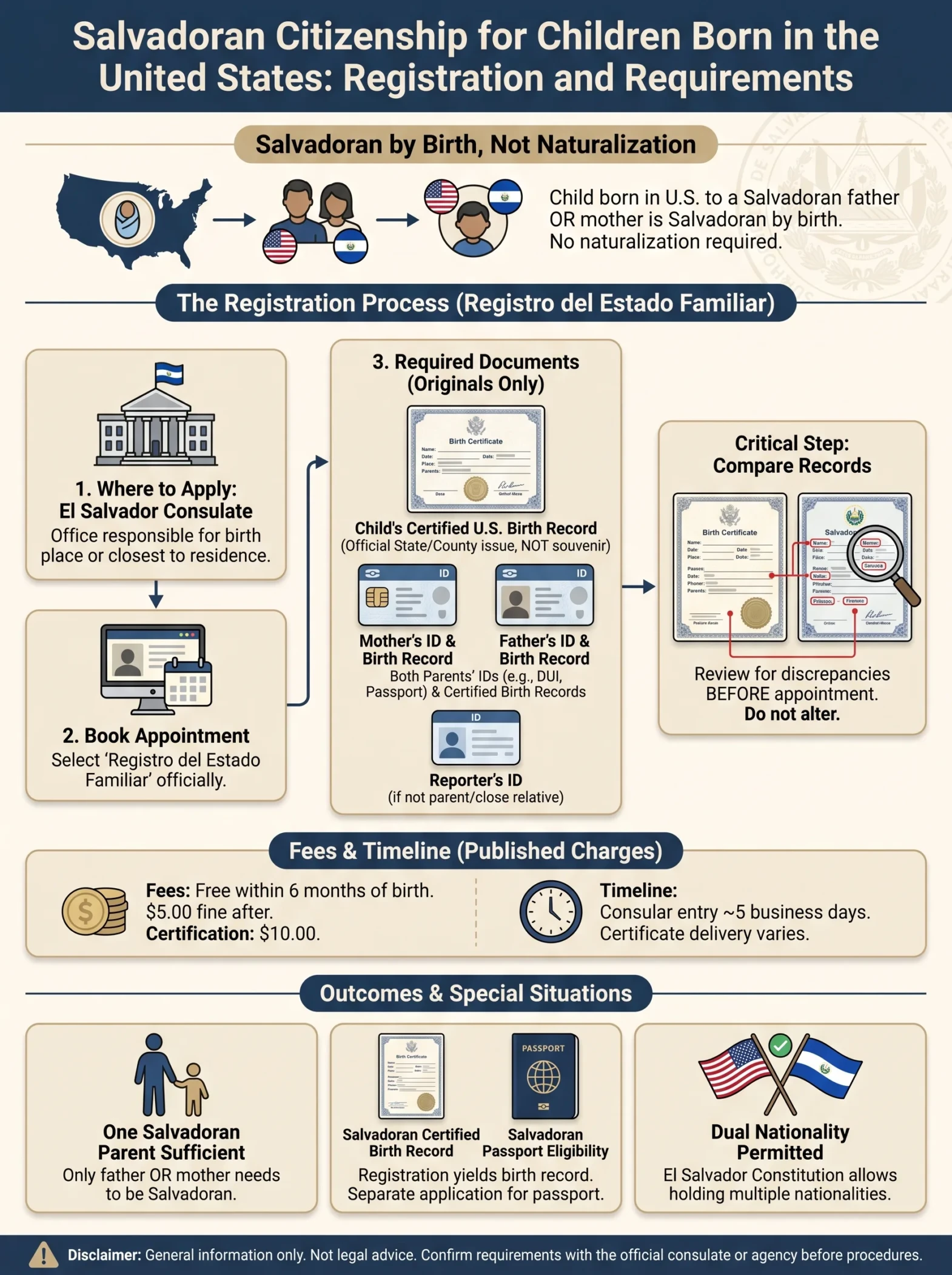
If your child was born in the United States and either the father or mother is Salvadoran, the Constitution of El Salvador recognizes the child as Salvadoran by birth. The child does not need to acquire Salvadoran nationality through naturalization. There is also an important terminology distinction: the Constitution defines “citizens” as Salvadorans who are 18 years of age or older. When people refer to the “Salvadoran citizenship” of a minor, they are usually referring to the child’s nationality and the documentation used to establish it. [1]
For a person born in the United States, the practical step is to register the birth in the Salvadoran civil registration system. Salvadoran jurisprudence has specifically distinguished this situation from naturalization: when someone was born abroad to a Salvadoran father or mother, the process is intended to document and register that status rather than make the person Salvadoran through naturalization. [2]
This is independent, general information. Cases involving disputed parentage, adoption, court orders, or significant inconsistencies between documents may require specific review by the appropriate civil registry or consular authority.
Registration Does Not Create Salvadoran Nationality
Three concepts are often mixed together. The place of birth may be California, Texas, New York, or anywhere else in the United States. Salvadoran nationality by birth may come through either the father or the mother. Salvadoran registration is the process used to incorporate that foreign birth into the Salvadoran Family Status Registry so that a Salvadoran birth certification can be issued.
Both parents do not have to be Salvadoran. A child whose mother is Salvadoran and whose father is a U.S. citizen, for example, falls under the constitutional rule just as a child whose father is Salvadoran and whose mother has another nationality does.
The fact that only one parent provides the Salvadoran nationality connection does not mean that only that parent’s documents will be used. The registration must also establish parentage, identity, and family information for both parents so that the birth record can be prepared correctly.
Documents Published for Registering a Birth From Abroad
The Ministry of Foreign Affairs’ official Family Status Registry information states that a birth occurring abroad may be registered through a Salvadoran diplomatic or consular representation. For a birth registration, the Ministry lists the foreign birth certification, identification documents for both parents, and birth certificates for both parents, all in original form. The same official page publishes the applicable consular fees. [3]
| Document | What to Prepare | What to Check |
|---|---|---|
| Child’s birth record | Original foreign birth certification | Name, date, place of birth, and parentage |
| Parents’ identification | Original identification documents for both parents | Names should correspond with the other civil records |
| Parents’ birth records | Original birth certifications for both parents | Surnames, given names, and information establishing parentage |
| Informant who is not a relative | Original and valid identity document | Applies when the person reporting the birth does not have the relationship specified in the consular requirements |
Which U.S. Birth Certificate Should Be Prepared?
The document relevant to this process is a certified copy of the official birth record. In the United States, certified copies are obtained from the vital records office of the state or territory where the birth occurred. The responsible authority and ordering procedure depend on that jurisdiction. [4]
Do not confuse this certification with documents provided by a hospital for medical, informational, or commemorative purposes. For Salvadoran civil registration, the relevant document is the official record issued by the government authority that maintains the birth registration.
The general requirements published by the Salvadoran Ministry of Foreign Affairs do not establish a nationwide “short form” or “long form” rule. Those terms are not used consistently across all U.S. states either. If the state offers several versions, check before ordering that the copy intended for the Salvadoran process contains enough information to identify the child and establish the relationship with the parents. If one version omits parentage information, confirm with the consular office whether that version is sufficient before paying for multiple copies.
Why Documents From Both Parents Are Requested
The constitutional rule requires one parent to be Salvadoran, but a birth registration contains family information that must be properly established. This helps explain why the consular requirements list identification and birth certificates for both parents.
If one parent was born in the United States, that parent’s birth document will come from the appropriate U.S. jurisdiction. If the Salvadoran parent has differences between the Salvadoran birth certificate and current documents—for example, a married surname, an omitted middle name, or a different presentation of two surnames—identify those differences before submitting the registration.
Registration Within and After Six Months
The Ministry of Foreign Affairs distinguishes between registering the event and later requesting a consular certification. The published Family Status Registry fees are:
| Service | Published Fee |
|---|---|
| Registration within the established period | No fee |
| Registration more than six months after the birth | US$5.00 penalty |
| Consular certification of a Family Registry record | US$10.00 |
The US$5.00 amount does not mean the person is paying to “obtain” Salvadoran nationality. The official fee schedule identifies it as a penalty for registration submitted more than six months after the event. It should also not be confused with the US$10.00 fee published for issuance of a consular certification.
Registration in the United States and Filing in El Salvador Require Different Preparation
A family living in the United States may process the registration through the Salvadoran diplomatic or consular representation corresponding to the place where the birth occurred or the office nearest the family’s residence. The Ministry of Foreign Affairs also states that people who are in El Salvador may process the matter through its Regional Offices.
This distinction matters especially when preparing a U.S.-issued document. The RNPN includes registration of legal events and acts occurring abroad among its services. Its information for this route states that documents originating abroad must be properly apostilled or authenticated and that documents in a language other than Spanish require a translation by a competent official. [5]
| Where the Process Begins | Treatment of the U.S. Document |
|---|---|
| Salvadoran representation in the United States | The general consular requirements request the original foreign birth certification and do not list an apostille or translation as universal requirements for birth registration. |
| Foreign document submitted for registration in El Salvador | RNPN information establishes authentication or apostille requirements and a competent translation when the document is in a language other than Spanish. |
Before paying for an apostille or translation: first determine where the document will actually be submitted. Do not automatically apply the requirements for a filing made in El Salvador to a consular appointment in the United States, or assume the reverse.
If a U.S. State-Issued Birth Record Must Be Apostilled
When an apostille is required for a vital record issued by a U.S. state and intended for use abroad, USAGov explains that the apostille is obtained from the designated authority of that state, commonly the Secretary of State’s office. A state birth certificate is not handled as a federal document. [6]
For that reason, someone born in Texas, California, or Virginia should not look for one federal office to apostille a state-issued birth certificate. The procedure depends on the state that issued the certified record.
Compare Names and Parentage Across Every Document Before the Appointment
For this process, simply gathering a stack of documents is not enough. The child’s U.S. birth record, the parents’ birth certificates, and their identity documents should allow the same family relationship to be followed without significant contradictions.
| Information | What to Compare |
|---|---|
| Child’s name | Spelling, additional given names, spacing, and order |
| Mother’s name | Birth surname compared with a surname used after marriage |
| Father’s name | One or two surnames, middle names, and abbreviations |
| Parents’ birth information | Dates and places of birth shown across their documents |
| Parentage | Whether the Salvadoran parent can be connected to the child through the documents presented |
A Different Surname May Require More Than a Translation
Not every difference is an error. A mother may appear under her birth surname on a Salvadoran birth certificate and use a married surname in the United States. A Salvadoran with two surnames may appear with only one surname on a U.S. document. A middle name may also appear in one record but not another.
The situation is different when the discrepancy is an actual error, such as a different birth date, an incorrect surname, a different person listed as a parent, or parentage that does not match. In that situation, do not attempt to make the records “match” by informally changing information. The authority receiving the application must determine whether the existing documents are sufficient or whether the original record needs a formal correction.
If the Salvadoran Parent Is Not Listed on the U.S. Birth Certificate
This is different from a spelling discrepancy. If the Salvadoran person through whom nationality is being established does not appear as the child’s father or mother on the birth record, the ordinary document package may not establish the relationship necessary to prepare the Salvadoran registration.
A later acknowledgment of paternity or maternity, an amended birth certificate, a court order, or another legal action concerning parentage can change which documents are required. Do not treat this situation as if it were only a misspelled name.
Situations That Change the Standard Registration File
When Only One Parent Is Salvadoran
The other parent does not need to apply for Salvadoran nationality. For nationality by birth, the connection through a Salvadoran father or mother is enough. The consular document list nevertheless requests identification and birth records for both parents because those records serve a separate civil registration purpose.
When One Parent Cannot Attend
The general birth-registration information lists original documents for both parents but does not provide, on that page, a detailed personal-appearance rule covering every possible situation. For that reason, do not automatically apply power-of-attorney or authorization rules from other procedures, such as a minor’s passport application, to the birth registration itself.
If only one parent will attend, inform the office handling the registration before traveling there. It should be clear who will act as the informant, where the other parent is located, and which original documents from that parent are available.
When the Child Was Never Registered and Is Now a Teenager or Adult
Passing the six-month mark is specifically contemplated by the consular fee schedule and does not, by itself, turn the case into a naturalization proceeding. Salvadoran judicial interpretation concerning people born abroad to Salvadoran parents also confirms that Salvadoran-by-birth status does not depend on completing naturalization.
If the person being registered is already an adult, state that age when requesting the service and do not assume the exact same package used for a newborn will cover every circumstance. The Ministry of Foreign Affairs publishes the basic documentation, but that general page does not describe every identification and appearance variation that may arise in a late registration involving an adult.
When the Salvadoran Connection Comes Through a Grandparent
Article 90 refers to children of a Salvadoran father or mother; it does not describe a direct grandparent-to-grandchild transmission rule. A person born in the United States, however, may already be Salvadoran by birth because one parent was Salvadoran and may, in turn, transmit that status to his or her own children.
↓
Parent born in the United States
↓
Child born in the United States
If the middle generation was never registered in El Salvador, that relationship may need to be documented first so the chain of parentage can be established before the next generation is registered.
Adoption, Custody, Name Changes, or Later Establishment of Parentage
A custody or guardianship order does not, by itself, replace a birth record establishing who the father or mother is. An adoption, a court-ordered legal name change, or later establishment of parentage may also affect the documentation needed to support the Salvadoran registration.
In these circumstances, bring certified court or civil records related to the change and explain the situation when requesting the service. The objective is not to accumulate documents, but to establish a clear documentary path from the original record to the person’s current identity and parentage.
From the Consular Appointment to the Salvadoran Birth Record
The Ministry of Foreign Affairs includes Family Status Registry services among the services available through its appointment portal for diplomatic and consular offices. [7]
- Identify the representation that will handle the case. Official information allows the process to be handled through the office corresponding to the place where the birth occurred or the representation nearest the family’s residence.
- Select the Family Status Registry service. Do not schedule a passport appointment assuming the birth registration can automatically be completed as part of the same procedure.
- Present the required originals. Include records explaining corrections, name changes, parentage, or legal representation when the case differs from a standard registration.
- Review the information that will be entered. Names, surnames, date and place of birth, and parentage should correspond with the documents supporting the registration.
- Confirm how to obtain the certification. Registering the birth and obtaining a certified copy of the Salvadoran record are related steps, but they should not be treated as if they were the same document or the same fee.
A single processing time should not be assumed for every consular office. Preparation of the record, its incorporation into the civil registry system, and the method for later obtaining a certification may depend on the route used and the circumstances of the file.
The Salvadoran Birth Record and Passport Are Separate Procedures
After registration, the person can have the birth documented within the Salvadoran civil registration system. This does not cancel or replace the U.S. birth certificate. They are records issued within two different civil registration systems for the same person, so both should be kept and their information should remain consistent.
A Salvadoran passport is not issued automatically either. For a first passport for a child or teenager abroad, the Ministry of Foreign Affairs publishes a separate procedure that requires, among other documents, an original Salvadoran birth certification issued within the year preceding the passport application. It also publishes specific rules concerning parental presence and situations in which one or both parents cannot accompany the minor. [8]
These are not the same document:
U.S. birth certificate = record of the birth in the United States
Salvadoran birth record = registration of the birth within the Salvadoran civil registration system
Salvadoran passport = travel document requested through a separate procedure afterward
Check the File Before Going to the Registration Appointment
- Original certified record of the birth that occurred in the United States.
- Original identification for the mother and father.
- Original birth certification for the mother and father.
- Comparison of names, surnames, dates, and places across all documents.
- Confirmation that the Salvadoran parent is properly connected to the child in the documentary record.
- Records supporting a legal name change, correction, acknowledgment of parentage, adoption, or court order when applicable.
- Confirmation of the route being used: a Salvadoran consulate in the United States or submission of the foreign document in El Salvador.
- Apostille and translation only according to the requirements of the route that actually applies.
- An appointment for the correct Family Status Registry service when the office uses scheduled appointments.
- An accepted form of payment when the late-registration penalty or issuance of a certification applies.
Official Sources
- [1] Constitution of the Republic of El Salvador — Legislative Assembly — Articles 71 and 90 distinguish citizenship from nationality by birth; Article 90 includes people born abroad to a Salvadoran father or mother.
- [2] Supreme Court of Justice — Registration of a Salvadoran Born Abroad — Explains that a person falling under Article 90, paragraph 2, is Salvadoran by birth and should not be treated as a naturalization case.
- [3] Family Status Registry — Ministry of Foreign Affairs — Publishes the procedures for registering events that occurred abroad, the documents requested for birth registration, and applicable consular fees.
- [4] How to Get a Certified Copy of a U.S. Birth Certificate — USAGov — Explains that certified copies of U.S. birth records are obtained through the vital records office of the appropriate state or territory.
- [5] Registration of Legal Events and Acts Occurring Abroad — RNPN — Provides official information for registration of births and other civil events occurring outside El Salvador, including legalization and translation requirements for foreign documents.
- [6] Authenticate an Official Document for Use Outside the U.S. — USAGov — Explains which authority issues apostilles for U.S. state documents, including vital records.
- [7] Appointment Portal — Ministry of Foreign Affairs — Confirms that Family Status Registry services are among the services available for appointments at diplomatic and consular offices.
- [8] Passports for Salvadorans Abroad — Ministry of Foreign Affairs — Details the official requirements for a first Salvadoran passport for children and teenagers and distinguishes that procedure from birth registration.