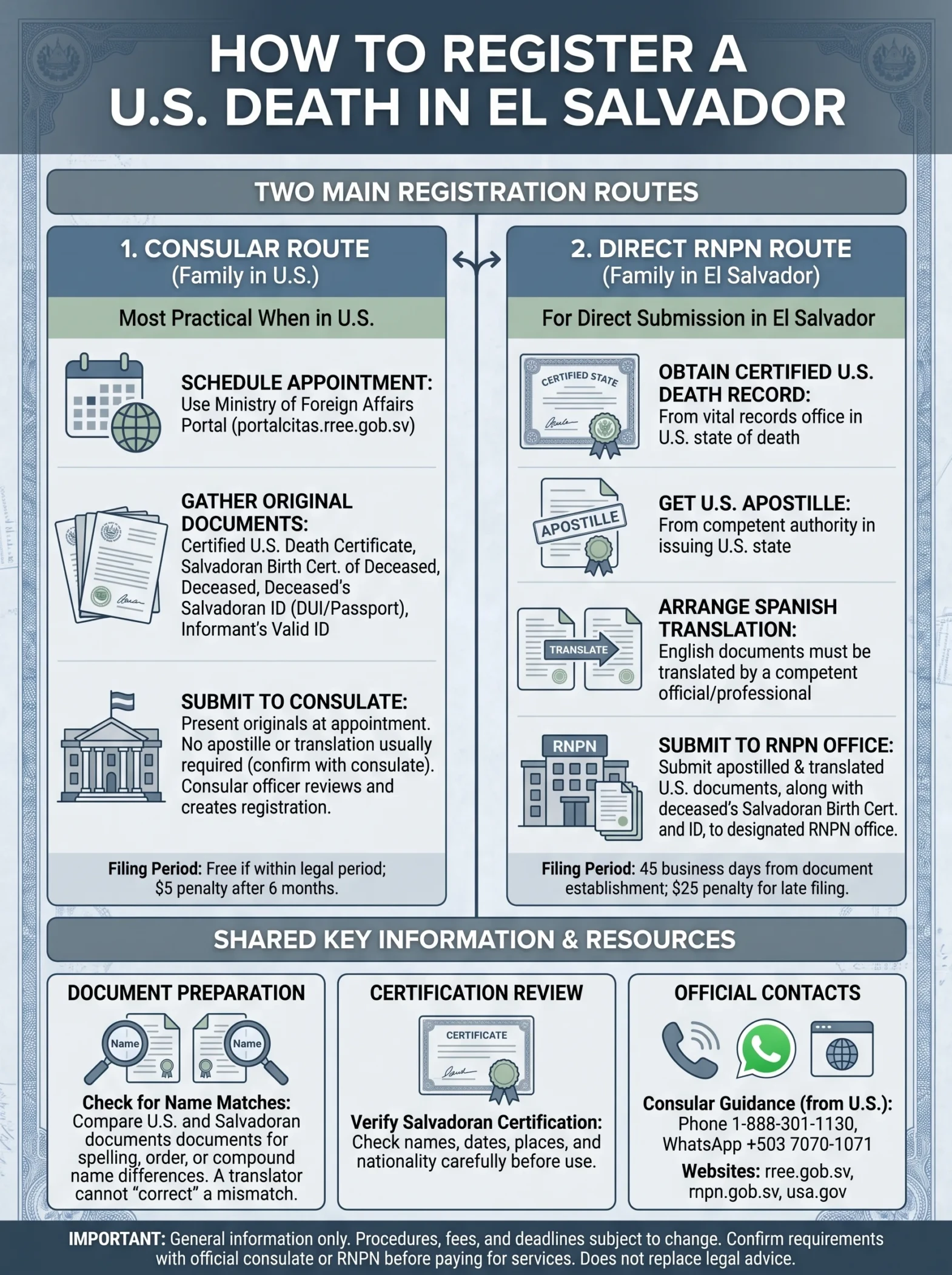
When a Salvadoran citizen dies in the United States, the U.S. death certificate does not automatically create a death registration in El Salvador. The death may be registered through a Salvadoran consulate in the United States or, if it was not registered through a consulate, through the procedure available in El Salvador for vital events that occurred abroad. The documents and preparation required depend on which route is used.[1]
If the family is in the United States
The death can generally be presented for registration at a Salvadoran consulate or diplomatic mission using the original documents required for the Family Status Registry.
If the documents will be presented in El Salvador
If the death was not previously registered through a Salvadoran consulate, the foreign document may be presented through the RNPN procedure for events that occurred abroad. Apostille or authentication and a Spanish translation may be required, depending on the document.
Independent information: this website is not a Salvadoran government office. This information is general in nature. When documents contain discrepancies, the death occurred many years ago, or special representation is required, the authority reviewing the case determines what additional steps or evidence are needed.
Start with the correct U.S. death certificate
For a death that occurred in the United States, the primary document should be a certified copy of the death certificate issued through the vital records system of the state where the death occurred. USAGov states that certified copies are obtained from the vital records office of the relevant state; fees, eligibility rules, and ordering methods vary by state.[2]
Do not prepare the Salvadoran registration using only a regular photocopy, hospital record, funeral home statement, or burial permit on the assumption that these documents have the same legal function. For the consular route, El Salvador’s Ministry of Foreign Affairs lists an original foreign death certification among the required documents.
Before spending money on an apostille, translation, or document shipping, compare the certified U.S. death certificate with the deceased person’s Salvadoran records. Check at least:
- full given names and surnames;
- date and place of birth;
- date and place of death;
- marital status, if listed;
- spouse’s name, when included;
- parents’ names, when included;
- any identification information that helps connect the U.S. record to the Salvadoran record.
Compare U.S. and Salvadoran names before filing
Name differences can matter when a person used only one surname in the United States, omitted a middle name, used a married surname, or had accents removed from Spanish names. For example, a U.S. certificate identifying someone as “Jose Hernandez” may not reproduce a Salvadoran birth record showing “José Antonio Hernández López.”
A minor difference does not automatically mean the registration will be rejected, but it should not be ignored. If the U.S. death certificate contains an actual error, determine whether the vital record should first be amended in the state that issued it. A translation should not be used to change information contained in the original record.
Documents published for consular death registration
For a death that occurred outside El Salvador, the Ministry of Foreign Affairs states that the registration may be handled through the Salvadoran diplomatic or consular mission corresponding to the place where the event occurred or the mission nearest the person’s place of residence. For a death registration, the published requirements include:
- the original foreign death certification;
- the deceased person’s original Salvadoran birth certificate;
- the deceased person’s original identification document;
- the original and valid identification document of the family member reporting the death;
- if the informant is not related to the deceased, documentation establishing legal, conventional, or judicial representation, together with the informant’s original identification.
The official list refers generally to the deceased person’s “identification document” rather than limiting the requirement to one particular document. If the family has only a DUI, passport, copy, or another form of identification, do not assume each will be accepted in the same way. Confirm with the consular office that will receive the application.
If the deceased person’s original ID cannot be found
This issue is better addressed before traveling to the consulate. The published requirement specifically calls for the deceased person’s identification document in original form. If the document was lost, retained by another institution, or only a copy remains, explain the situation to the consular office and ask what alternative evidence may be accepted to connect the U.S. death certificate with the Salvadoran civil record.
Do not assume that a photograph of a DUI, a printout of a digital image, or a notarized copy automatically replaces the original requirement without confirmation from the office handling the case.
Choose the Family Status Registry service when making the appointment
The Ministry of Foreign Affairs appointment portal includes Family Status Registry services among the services available through Salvadoran diplomatic and consular missions.[3] When scheduling, make sure the appointment corresponds to a death or family registry service rather than passport, DUI, or general documentation services.
Do not pay for an apostille for the consular route before confirming it is required
The Ministry of Foreign Affairs’ general list for registering a death through a Salvadoran consulate names the original foreign death certification, Salvadoran birth record, and identification documents. It does not separately list an apostille or translation among the principal published requirements for that consular procedure.
Before paying for an apostille: if the death will be registered directly through a Salvadoran consulate in the United States, confirm with that specific office whether it requires an apostille, translation, or a particular version of the death certificate. Requirements for documents presented directly in El Salvador should not automatically be applied to the consular route.
The five-business-day rule is not a guaranteed total processing time
El Salvador’s Family Status Registry Law provides that consular officials use the RNPN information system when registering these events abroad. The law also gives the consular official five business days to enter the covered events and legal acts into that system.[4]
That rule concerns the registration duty established by law. It does not mean that obtaining an appointment, resolving missing documents, correcting discrepancies, completing review, and receiving a final certification are all guaranteed to be finished within five business days.
When the documents will be filed directly in El Salvador
The procedure changes when the death of a Salvadoran citizen was not previously registered through the corresponding Salvadoran consulate. Article 92 of the Family Status Registry Law assigns the RNPN responsibility for registering qualifying events that occurred outside Salvadoran territory and allows supporting foreign documents to be submitted by an interested person at offices designated by the RNPN.
In June 2026, the RNPN also published a specific service page for “Inscripciones de hechos y actos jurídicos en el exterior,” covering registrations of events and legal acts occurring abroad. Its informational material includes deaths and states that foreign documents are subject to authentication or apostille requirements and must be translated when they are written in a language other than Spanish.[5]
For a death certificate originally issued in English, the document sequence for this route generally involves:
- obtaining a certified copy of the death certificate from the U.S. state where the death occurred;
- checking the information against the deceased person’s Salvadoran documents;
- obtaining the appropriate apostille or authentication;
- preparing the required Spanish translation;
- gathering Salvadoran records that establish the deceased person’s identity;
- presenting the documents at an RNPN office authorized to process registrations of events occurring abroad.
A state-issued death certificate uses a state apostille, not a federal one
Vital records issued by a U.S. state are state documents. USAGov explains that when a state-issued vital record requires an apostille, the apostille is obtained through the Secretary of State or other designated authority of the state that issued the document. Federal documents follow a different authentication process through the U.S. Department of State.[6]
El Salvador is a contracting party to the 1961 Hague Apostille Convention, which entered into force for El Salvador in 1996.[7] U.S. states may still have their own procedures for preparing a vital record before an apostille is issued, so follow the instructions of the state authority that issued the death certificate.
Document sequence for direct filing in El Salvador
State-certified death certificate → appropriate apostille → Spanish translation when required → Salvadoran identity records → filing with the RNPN office authorized to process events that occurred abroad.
The translation must reproduce the document, not correct it
The Family Status Registry Law requires supporting documents from abroad that are written in a language other than Spanish to be translated by a competent official or professional under the applicable requirements. Do not assume that every commercial translation service automatically meets the RNPN standard; confirm the type of translation accepted by the office receiving the documents before paying for the service.
If a U.S. certificate says “Maria Lopez” while Salvadoran records identify the person as “María Elena López Hernández,” the translator should not change the U.S. record to make the names match. An identity discrepancy must be addressed through supporting records or the appropriate correction procedure, not by altering the translation.
The published US$5 and US$25 penalties apply to different situations
Two different penalty rules appear in official Salvadoran sources. They should be understood according to the registration route being used, not treated as two optional prices for the same procedure.
| Situation | Published amount | What it covers |
|---|---|---|
| Consular registration within the published period | Exempt | Registration completed through the Salvadoran consular mission within the applicable period. |
| Consular registration after six months | US$5 | Penalty currently shown on the Ministry of Foreign Affairs consular fee information. |
| Consular Family Registry certification | US$10 | Fee for issuance of the certification; this is separate from creation of the registration itself. |
| Late direct registration with the RNPN under Article 92 | US$25 | Penalty established by law for qualifying events abroad that were not registered through a consulate and are presented after the period specified for this route. |
For direct registration with the RNPN, Article 92 establishes a maximum period of 45 business days following the date on which the event was established through the corresponding document. The law does not simply say “45 days from the date of death.” A family therefore should not calculate the possible penalty solely by counting from the day the person died.
The Ministry of Foreign Affairs consular information, by comparison, continues to publish a US$5 penalty for registration after six months. For an older death or a case already outside ordinary filing periods, first identify whether the case will proceed as a consular registration or a direct RNPN registration. The receiving authority can then determine which rule applies to that filing.
The cost of ordering the U.S. death certificate, obtaining an apostille, translating documents, or shipping records is separate from these Salvadoran amounts. Those expenses depend on the U.S. state and any private services used.
Review the Salvadoran death registration before using it elsewhere
Salvadoran law provides that a death registration may contain information such as an identification number or NUI when available, names and surnames, date of birth, sex, marital status, nationality, birthplace, domicile, spouse and parent information, as well as the place, date, time, and cause of death.
Once a Salvadoran certification is available, compare it with the original records before using it for another procedure. Pay particular attention to:
- full names and surnames;
- date and place of birth;
- nationality;
- date and place of death;
- spouse information;
- parents’ names;
- any identification number, NUI, or registry information shown on the certification.
If the U.S. death certificate is correct but the Salvadoran registration contains an incorrect entry, the problem should not be treated as a translation issue. The Family Status Registry Law provides mechanisms for corrections and rectifications affecting civil registry records, including death registrations.
Situations that may require different preparation
The death occurred many years ago
A valid U.S. death certificate may exist even though the death was never registered in El Salvador. For an older death, first gather the U.S. certificate and all available Salvadoran records. The age of the case may affect deadlines, penalties, and how identity is established, especially when the deceased person’s original Salvadoran identification can no longer be found.
The deceased person was not Salvadoran
The procedure described here concerns the registration in El Salvador of deaths of Salvadoran citizens that occurred abroad. A U.S. death certificate for a person who was not Salvadoran may still be needed in El Salvador for an inheritance, pension, insurance claim, marriage record, or another legal matter, but that does not automatically mean a Salvadoran death registration should be created through this procedure.
The deceased person was also a U.S. citizen
Having another nationality does not turn a U.S. death certificate into a Salvadoran civil registry entry. If the deceased also held Salvadoran nationality, the practical issue is establishing the person’s identity within the Salvadoran registry system and documenting the death that occurred in the United States.
The person reporting the death is not a family member
For the consular route, the Ministry of Foreign Affairs publishes a specific requirement: when the informant is not related to the deceased, the person must establish legal, conventional, or judicial representation and present original identification.
For direct presentation of foreign documents, Article 92 permits documents to be submitted by an interested person. The ability to deliver the documents should not be interpreted as automatic authority to represent the family in every additional legal or administrative matter that may arise.
Death registration does not repatriate remains or automatically resolve other matters
Registering a death in El Salvador and repatriating human remains or ashes are separate procedures. El Salvador’s Ministry of Foreign Affairs maintains a specific assistance process for families requesting repatriation of Salvadorans who died abroad, involving Salvadoran diplomatic or consular missions and other relevant authorities.[8]
A Salvadoran citizen may be buried or cremated in the United States while the family still needs to register the death in El Salvador. Likewise, transporting remains to El Salvador does not mean that a Family Status Registry death entry has automatically been created.
The death registration also does not distribute an inheritance, close bank accounts, collect life insurance, automatically update a surviving spouse’s DUI, or complete notifications required by U.S. agencies. Those procedures may require a death certificate or Salvadoran certification as supporting evidence, but they have their own requirements.
If you need to confirm a case before traveling: the Ministry of Foreign Affairs contact page lists the Virtual Consulate at 1-888-301-1130 for the United States and Canada and WhatsApp at +503 7070-1071.[9]
Official Sources
- [1] Family Status Registry — Ministry of Foreign Affairs of El Salvador — Publishes the procedures for registering vital events that occurred abroad, the documents required for a death registration, and currently listed consular fees.
- [2] How to Get a Certified Copy of a Death Certificate — USAGov — Explains where to obtain a certified copy when a death occurred in the United States and notes that eligibility, fees, and ordering procedures vary by state.
- [3] Appointment Portal — Ministry of Foreign Affairs of El Salvador — Confirms that Family Status Registry services are among the services available through Salvadoran diplomatic and consular missions.
- [4] Family Status Registry Law — RNPN — Governs consular and direct registration of events occurring abroad, the consular official’s registration period, the 45-business-day provision, the US$25 penalty, and requirements for foreign documents.
- [5] Registration of Events and Legal Acts Occurring Abroad — RNPN — RNPN service information published in 2026 that includes deaths and describes apostille or authentication and translation requirements for foreign documents.
- [6] Authenticate an Official Document for Use Outside the U.S. — USAGov — Distinguishes state and federal apostille procedures and explains that state-issued vital records are handled through the issuing state.
- [7] Apostille Convention — Status Table — HCCH — The Hague Conference’s official status table showing El Salvador’s participation in the 1961 Apostille Convention.
- [8] Assistance With Repatriation of Salvadorans Who Died Abroad — Ministry of Foreign Affairs — Describes repatriation as a separate consular assistance process rather than part of the civil death registration itself.
- [9] Contact Us — Ministry of Foreign Affairs of El Salvador — Publishes Virtual Consulate contact channels for users in the United States and through WhatsApp.