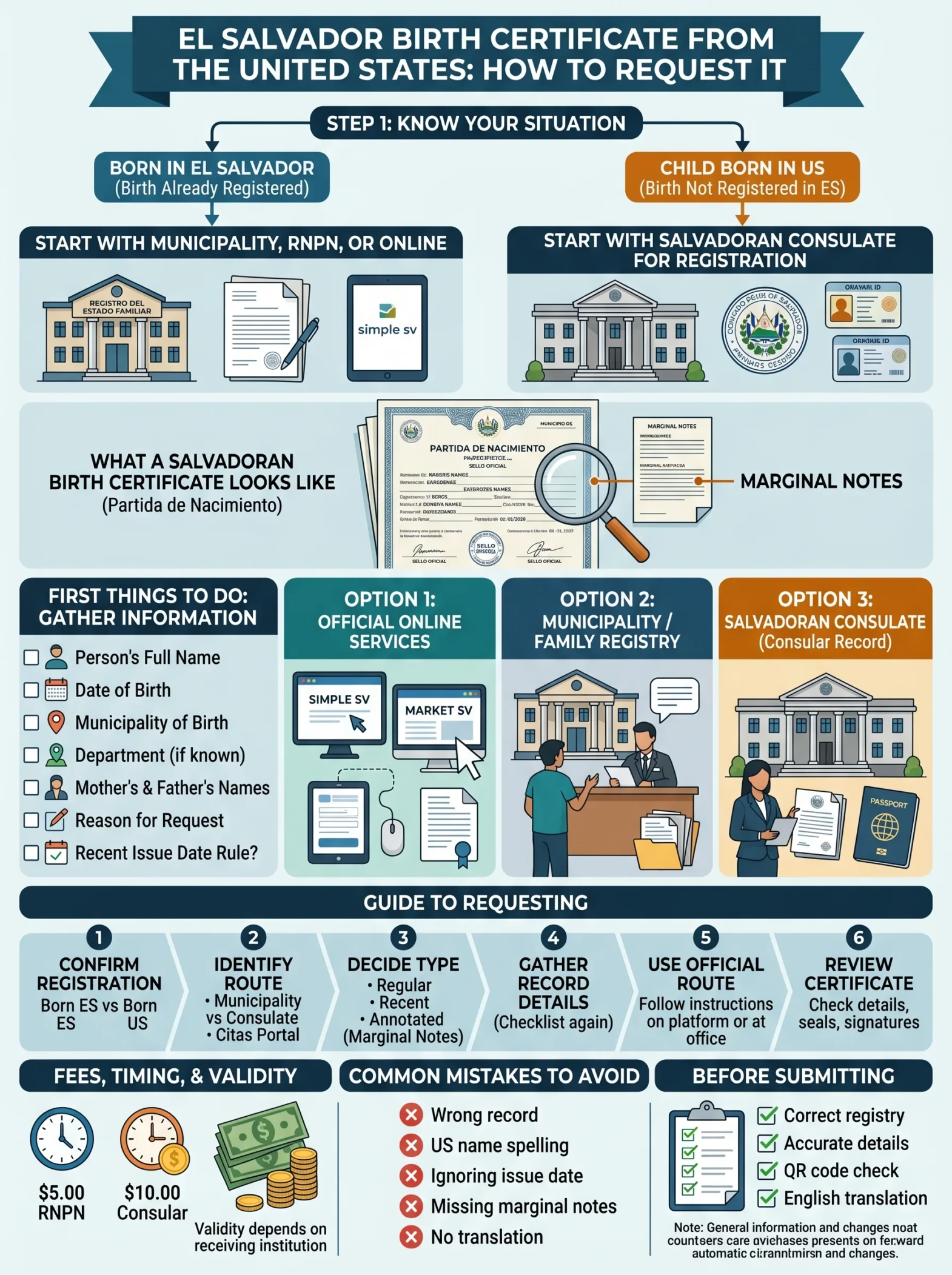
Requesting an El Salvador birth certificate from the United States is usually a matter of knowing where the birth was registered, which version of the certificate you need, and whether your case can be handled online, through a family member in El Salvador, or with help from a Salvadoran consulate. The confusing part is that people often use one phrase — “birth certificate” — for different situations: a certificate for someone already registered in El Salvador, a recent certificate needed for DUI or passport paperwork, or a new birth registration for a child born in the United States.
Keep the process simple at the beginning. First, identify whether the birth is already registered in El Salvador. Then confirm what the receiving office wants: a regular certificate, a recent certificate, a certificate with marginal notes, a certified translation, or a consular record.
Quick answer: If the person was born in El Salvador and the birth was registered there, start with the municipality’s Registro del Estado Familiar, RNPN services, or the official online platforms referenced by Salvadoran authorities, such as Simple SV or Market SV. If the person was born in the United States to Salvadoran parents and the birth has not yet been registered with El Salvador, the first step is usually a birth registration through a Salvadoran consulate, not a duplicate certificate.
Important: This page is for general information only. It is not an official government page and it is not legal advice. Requirements, fees, online systems, appointment availability, and document wording can change. Always confirm the latest details with the official Salvadoran consulate, RNPN, municipality, Simple SV, Market SV, or the agency that will receive your document before you take action.
Who This Guide Is For
This guide is for Salvadorans in the United States, Salvadoran families, parents, adult children, spouses, and English-speaking relatives who are trying to request a birth certificate from El Salvador without getting lost between online platforms, consular services, and municipal records.
It can help if you are trying to:
- Get your own Salvadoran birth certificate while living in the United States.
- Request a parent’s, child’s, or spouse’s certificate for a family process.
- Prepare documents for a Salvadoran DUI, Salvadoran passport, marriage record, family matter, or administrative process.
- Understand whether you need a recent certificate or one with marginal notes.
- Register the birth of a child born in the United States to Salvadoran parents.
- Use a Salvadoran birth certificate for a U.S. immigration or legal process that may require an English translation.
First, Know Which Situation You Are In
Before you request anything, make sure you are asking for the right type of service. This avoids a common mistake: trying to request a certificate online when the birth has not yet been registered with El Salvador, or booking a consular appointment when the document can be requested through a registry or online service.
| Your situation | Where to start | What to check first |
|---|---|---|
| You were born in El Salvador | The Family Registry of the municipality where the birth was registered, RNPN services, or official online platforms. | Full name, date of birth, place of birth, parents’ names, and whether you need a recent issue date. |
| Your child was born in the United States | A Salvadoran consulate for birth registration in the Salvadoran family registry system. | Foreign birth certificate, parents’ IDs, parents’ Salvadoran birth certificates, and appointment rules. |
| You need the certificate for DUI or passport paperwork | Confirm the document age requirement with the office handling the DUI or passport process. | Some Salvadoran consular services ask for an original and recent birth certificate. |
| You need it for USCIS or a U.S. legal process | Request the official Salvadoran certificate first, then check translation rules with the receiving agency. | USCIS generally requires a full English translation with translator certification for foreign-language documents. |
What a Salvadoran Birth Certificate Usually Means
In El Salvador, a birth certificate is commonly referred to as a partida de nacimiento or certificación de partida de nacimiento. For official purposes, the certificate comes from the family registry records connected to the place where the birth was registered. The U.S. Department of State describes Salvadoran birth certificates as available documents issued by the Registro del Estado Familiar of the city where the birth took place, and notes that certified copies are available.[1]
That matters because the correct registry is usually tied to the municipality, not simply the country. If someone was born in San Miguel, Santa Ana, San Salvador, La Unión, Sonsonate, Usulután, or another municipality, the record is normally connected to the family registry where the birth was recorded.
The RNPN also describes its certification service as a document that certifies the records found with the data provided in the Salvadoran vital and family registry system. The RNPN page lists the type of data generally needed for the request, including the person’s name, date of birth, place of birth, and parents’ names if available.[2]
The First Thing To Do
Start by writing down the information that identifies the record. Do this before opening an online account, contacting a consulate, or asking a relative in El Salvador to help.
Before you start: Prepare the basic data first.
- Full name exactly as it appears on Salvadoran records.
- Date of birth.
- Municipality or city where the birth was registered.
- Department, if known.
- Mother’s full name.
- Father’s full name, if listed.
- Reason you need the certificate.
- Whether the receiving office asked for a recent certificate.
- Whether the document needs marginal notes, corrections, or annotations.
If you are helping someone else, ask them for the names as they appear on Salvadoran documents, not only the name used in the United States. Small differences can matter, especially if the certificate will be used for a DUI, passport, immigration filing, marriage record, or court-related process.
Main Ways To Request a Birth Certificate From the United States
There is not one single path for every case. The practical route depends on whether the birth is already registered in El Salvador and what type of certificate you need.
Option 1: Request it through official online services
For many people living in the United States, the most convenient place to check first is the official online route. Salvadoran official pages for consular services mention that a birth certificate can be requested through Simple SV or Market SV in certain document-preparation contexts, such as when a birth certificate is needed for Salvadoran identity procedures abroad.[3]
Official link: You can check the Salvadoran government’s digital services through Simple SV and Market SV. If a platform is under maintenance or does not show your exact service, confirm directly with the official office before paying or submitting information.
This route may work best when the birth is already registered in El Salvador and you have enough information to locate the record. The platform may ask you to create an account, enter identity information, choose the type of document, complete the request, and pay through the available method. Because online systems can change, treat the platform instructions as the current rule at the time you use it.
Option 2: Request it through the municipality or Family Registry in El Salvador
If the online route does not work, the traditional source is the Registro del Estado Familiar connected to the municipality where the birth was registered. The U.S. Department of State states that Salvadoran birth certificates are issued by the Family Registry of the city where the birth took place and that requests can be made verbally or in writing to the relevant registry official.[4]
People in the United States often ask a trusted relative in El Salvador to help with this step. Before doing that, confirm whether the registry will release the certificate to that person, what identification they must show, whether authorization is needed, and whether the receiving office will accept the version issued by that municipality.
Option 3: Ask the Salvadoran consulate when your case involves a consular record
A Salvadoran consulate is especially important when the event happened outside El Salvador and needs to be recorded in El Salvador’s family registry system. The Ministry of Foreign Affairs says that births, marriages, and deaths of Salvadorans that occur abroad may be registered through the Salvadoran diplomatic or consular representation corresponding to the place where the event occurred or the one closest to the person’s residence.[5]
This is different from simply ordering a duplicate certificate. For example, if a child was born in the United States to Salvadoran parents and the birth has not yet been registered with El Salvador, the family may need to complete the Salvadoran birth registration process first. After the birth is properly registered, the family can ask how to obtain the certificate or certification that proves the record.
Step-by-Step: How To Request It Without Getting Confused
Step 1: Confirm that the birth is already registered
Ask a simple question first: Was this birth already registered in El Salvador or through a Salvadoran consulate?
If the person was born in El Salvador, the answer is usually yes, unless there was a registration problem. If the person was born in the United States, do not assume the birth is already in Salvadoran records. A U.S. birth certificate by itself is not the same as a Salvadoran birth registration.
Step 2: Identify the municipality or consular route
For a person born in El Salvador, identify the municipality where the birth was recorded. For a person born in the United States, identify the Salvadoran consulate that handles the family’s location or the nearest office offering family registry services.
The official appointment portal of the Ministry of Foreign Affairs lists Registros del Estado Familiar among the consular services available through the appointment platform, together with passport services, notarial acts, documentation services, visas and foreigner services, and DUI procedures.[6]
Step 3: Decide whether you need a regular, recent, or annotated certificate
Not every office asks for the same version. Some uses may require a recent certificate. Others may need a certificate that shows marginal notes, corrections, recognition of paternity, name changes, adoption-related updates, marriage annotations, or other registry changes.
For Salvadoran DUI procedures abroad, the Ministry of Foreign Affairs lists an original and recent birth certificate that does not exceed 12 months from issuance for first-time DUI requests, and also points users to Simple SV or Market SV to request the certificate.[7] That does not mean every agency uses the same age rule, but it shows why you should ask the receiving office how recent the document must be.
Step 4: Gather the identifying information
Have the record details ready before submitting the request. If a name has changed in the United States, use the Salvadoran name first and then keep proof of the name change ready if the receiving agency asks for it.
Helpful record details:
- Full Salvadoran name of the person on the record.
- Exact or approximate date of birth.
- Municipality and department of birth.
- Mother’s full name, including surnames.
- Father’s full name, if applicable.
- DUI number or passport number, if the platform asks for identity verification.
- Contact email and phone number for notifications.
- Delivery address, if physical delivery is available for your request.
Step 5: Use the official route that matches your case
If your certificate can be requested online, follow the instructions on the official platform. If the online platform cannot locate the record, contact the municipality, RNPN, or the relevant consulate for guidance. If a relative will help in El Salvador, ask the registry what that person must present before they go.
Do not rely only on screenshots, old social media posts, or unofficial lists of fees. Birth certificate requirements are practical details that can change by office, platform, municipality, or receiving agency.
Step 6: Review the certificate as soon as you receive it
Before sending the certificate to USCIS, a school, a consulate, a court, an attorney, or another agency, read it carefully. Check the name, date of birth, parents’ names, registry office, seals, signatures, QR code if included, marginal notes, and issue date.
If something looks wrong, ask the issuing office how corrections are handled. Do this before translating, mailing, or submitting the certificate, because fixing an error later can take more time.
Documents and Information You May Need
The exact requirement depends on the route. An online request may ask for account information and record data. A municipal request may ask for the identifying details of the person whose record is needed. A consular birth registration for a child born in the United States may ask for parents’ identity documents and the child’s U.S. birth certificate.
| Route | You may need | Why it matters |
|---|---|---|
| Online request | Account access, personal data, record details, payment method, email, delivery information. | The platform needs enough information to locate the correct record. |
| Municipal or registry request | Full name, date of birth, place of birth, parents’ names, requester identification, possible authorization. | The registry must identify the correct record and confirm how it can be released. |
| Consular birth registration | Foreign birth certificate, parents’ IDs, parents’ Salvadoran birth certificates, appointment confirmation, and any extra consular requirement. | This is used when a birth abroad must be entered into Salvadoran family registry records. |
| Use before a U.S. agency | Official certificate, complete English translation if required, copy of the original, and any agency-specific instructions. | U.S. agencies may have document and translation rules separate from Salvadoran issuing rules. |
Fees, Timing, and Validity
Fees and timing can vary by route. Some information is listed by official sources, but you should still confirm at the moment you request the document.
| Item | Officially listed information | What it means for you |
|---|---|---|
| RNPN certificate service | RNPN lists a $5.00 service cost and a waiting time of two hours from the entry of the request form.[8] | Useful when handling a certificate through RNPN services in El Salvador. Online or delivery costs may be different. |
| Municipal birth certificate fees | The U.S. Department of State notes that birth certificate fees vary by city hall and gives a range of $3.00 to $5.00.[9] | The amount can depend on the municipality and the type of request. |
| Consular family registry certification | The Ministry of Foreign Affairs lists $10.00 for issuance of consular certifications of family registry records.[10] | This applies to consular family registry certifications, not necessarily every online or municipal certificate request. |
| Late registration abroad | The Ministry of Foreign Affairs lists family registry registration within the legal term as exempt from payment and lists a $5.00 fine after six months of the event.[11] | This is relevant when registering a birth, marriage, or death abroad, not simply requesting a duplicate certificate. |
| Document validity | RNPN states that the issued certification does not have its own expiration period and that validity depends on the institution where it is presented.[12] | Even if the certificate itself does not expire, the receiving office may ask for one issued within a recent period. |
If You Were Born in El Salvador
If you were born in El Salvador and need your own certificate from the United States, your process is usually about obtaining a certified copy of an existing record. Start by finding the municipality where the birth was registered.
Then check whether the certificate can be requested through Simple SV, Market SV, RNPN services, the municipality, or a trusted person in El Salvador. If the record is old, handwritten, damaged, or hard to locate, the office may need more information.
Keep this simple:
- Find the municipality of registration.
- Prepare full name, birth date, and parents’ names.
- Check online request options first.
- If online does not work, contact the registry, RNPN, or a trusted helper in El Salvador.
- Ask the receiving office how recent the certificate must be.
If Your Child Was Born in the United States
If your child was born in the United States and you want the child’s Salvadoran record, the process is usually not just “ordering a birth certificate.” It may begin with registering the U.S. birth with El Salvador through a Salvadoran consulate.
The Ministry of Foreign Affairs says births of Salvadorans that happen abroad may be registered through a Salvadoran diplomatic or consular representation. For birth registration, the page lists documents such as the foreign birth certificate in original, original identification documents of both parents, and original birth certificates of both parents.[13]
Before booking, contact the consulate or check the appointment portal to confirm whether the U.S. birth certificate needs a specific format, whether apostille or translation is required, whether both parents must attend, and what happens if one parent cannot appear.
If You Need the Birth Certificate for a Salvadoran DUI
If the certificate is for a Salvadoran DUI appointment in the United States, do not request an old copy without checking the issue-date rule. The consular DUI page lists a birth certificate that is original and recent, not exceeding 12 months from issuance, for first-time DUI procedures abroad.[14]
That is why many people request a fresh certificate close to the appointment date. If your appointment is months away, check whether it is better to wait until you are closer to the appointment so the certificate remains within the accepted period.
If You Need the Certificate for a Salvadoran Passport
For a Salvadoran passport, the birth certificate requirement depends on the applicant’s age and situation. A minor, a first-time applicant, a replacement case, a correction, or a case with new marginal notes may require different documents.
Before requesting the certificate, check the consular passport instructions for your case and ask whether the birth certificate must be recent, original, marginated, or issued within a certain number of months. This is especially important for minors and for cases involving recognition of paternity, adoption, name corrections, or parents who cannot both attend.
If You Need It for USCIS or Another U.S. Process
If you will submit the Salvadoran birth certificate to USCIS, a U.S. court, a school, a benefits office, or another U.S. institution, the Salvadoran issuing rules are only one part of the process. The receiving U.S. agency may have its own requirements.
For USCIS filings, federal regulations state that any document containing a foreign language must be accompanied by a full English translation, and the translator must certify that the translation is complete and accurate and that they are competent to translate from the foreign language into English.[15]
Translation note: If the certificate will be used for immigration, do not guess about translation rules. Check the form instructions, USCIS guidance, or a qualified immigration attorney if your case is sensitive. A translation issue can delay a filing even when the Salvadoran certificate itself is correct.
What Can Change Before You Request It
Birth certificate requests feel simple, but several practical details can change. Check these points before you pay, mail documents, or travel to a consulate.
What may change:
- Online platform availability.
- Payment methods.
- Delivery options to the United States.
- Municipal fee amounts.
- Consular appointment availability.
- Document age rules for DUI, passport, or other procedures.
- Whether a certificate with marginal notes is needed.
- Whether a U.S. agency requires translation, apostille, or other formatting.
Common Mistakes That Can Slow You Down
Most delays come from small preparation problems, not from the certificate itself. These are the mistakes to avoid.
Requesting the wrong record
If the person was born in the United States and never registered with El Salvador, there may not be a Salvadoran birth certificate to order yet. In that case, ask the consulate about birth registration first.
Using U.S. name spelling instead of Salvadoran registry spelling
Names may appear differently across U.S. and Salvadoran documents. Use the Salvadoran registry spelling when searching for the record, and keep supporting documents ready if names differ.
Ignoring the issue date
Some offices want a certificate issued recently. Even if a certificate does not have its own expiration date, the office receiving it may set a recency rule.
Not checking marginal notes
If there has been a correction, recognition of paternity, marriage annotation, adoption-related update, or name change, ask whether the certificate must show marginal notes.
Submitting a Spanish document without the required English translation
For U.S. immigration filings, the translation requirement is separate from the Salvadoran certificate request. Check translation rules before submitting the document.
Before You Submit or Use the Certificate
Final checklist:
- Confirm the certificate was issued by the correct registry or official service.
- Check full name, date of birth, place of birth, and parents’ names.
- Review seals, signatures, QR code, and registry information.
- Check whether the receiving office needs a recent issue date.
- Ask whether marginal notes must appear.
- Make a clear copy for your records before mailing anything.
- If using it in the United States, confirm whether a certified English translation is required.
- If the document is for a consular appointment, recheck appointment instructions before the appointment day.
Resumen en español
Si usted vive en Estados Unidos y necesita una partida de nacimiento de El Salvador, primero confirme si el nacimiento ya está registrado en El Salvador. Si la persona nació en El Salvador, normalmente debe buscar la certificación por medio del Registro del Estado Familiar del municipio, RNPN, Simple SV, Market SV o la vía oficial que corresponda.
Si el niño o niña nació en Estados Unidos y todavía no está inscrito en El Salvador, probablemente el primer paso sea hacer el registro de nacimiento en el consulado salvadoreño. Después de que el registro exista, podrá preguntar cómo obtener la certificación correspondiente.
Antes de pedir el documento, tenga listos el nombre completo, fecha de nacimiento, lugar de nacimiento y nombres de los padres. Si la partida será usada para DUI, pasaporte, USCIS u otro trámite, confirme si debe ser reciente, marginada o traducida al inglés.
FAQ
Can I request an El Salvador birth certificate online from the United States?
In many cases, you can start online through official Salvadoran digital services such as Simple SV or Market SV, especially if the birth is already registered in El Salvador. If the platform cannot locate the record, contact the municipality, RNPN, or the relevant consulate.
What information do I need to request a Salvadoran birth certificate?
You should prepare the person’s full name, date of birth, place of birth, municipality, and parents’ names. If you are requesting it for someone else, ask the official office whether identification or authorization is needed.
Does a Salvadoran birth certificate expire?
RNPN states that the certification itself does not have its own expiration period and that validity depends on the institution where it is presented. In practice, many offices still ask for a certificate issued recently, so check the rule for your specific process.
What if I was born in the United States to Salvadoran parents?
If your birth was never registered with El Salvador, you may need to complete a Salvadoran birth registration through a consulate first. A U.S. birth certificate does not automatically create a Salvadoran birth registry record.
Can a family member in El Salvador request my birth certificate?
Sometimes a trusted person in El Salvador may be able to help, but rules can vary by municipality or service. Before sending someone, confirm what identification, authorization, and payment method the registry requires.
Do I need a certified translation for USCIS?
If the birth certificate is in Spanish and you submit it to USCIS, federal rules generally require a full English translation with translator certification. Check the form instructions or speak with a qualified immigration attorney if your case has legal complications.
What if my name is different on U.S. documents?
Request the Salvadoran record using the name shown in Salvadoran registry records. If your U.S. documents show a different name, ask the receiving office what proof of name change or supporting document they require.
Should I request the certificate before booking a consular appointment?
It depends on the process. If the appointment requires a recent birth certificate, check how recent it must be before ordering. You do not want the certificate to be too old by the time your appointment arrives.
Official Sources
- [1] U.S. Department of State — El Salvador Reciprocity and Civil Documents — This page explains how Salvadoran birth certificates are treated for U.S. visa document purposes, including issuing authority, availability, certified copies, and general fee range. It is a U.S. government source used for civil document verification.
- [2] RNPN — Certificación de partidas en El Salvador — This official RNPN page describes the certification service, data needed for the request, validity explanation, QR verification, waiting time, and service cost.
- [3] Ministerio de Relaciones Exteriores — Documento Único de Identidad en el exterior — This official consular service page lists birth certificate requirements for DUI procedures abroad and references Simple SV and Market SV as places to request the birth certificate.
- [4] U.S. Department of State — Birth Certificates in El Salvador — This official U.S. reference explains that requests are addressed to the Family Registry of the city where the birth was registered and also notes online request availability.
- [5] Ministerio de Relaciones Exteriores — Registro del Estado Familiar — This official Salvadoran consular page explains registration of births, marriages, and deaths abroad, consular registry fees, and documents required for birth registration.
- [6] Ministerio de Relaciones Exteriores — Portal de Citas — This official page explains that the appointment portal is used for visits to diplomatic and consular offices and lists family registry services among available appointment categories.
- [7] Ministerio de Relaciones Exteriores — DUI requirements abroad — This official consular page supports the point that certain Salvadoran identity procedures abroad may require an original and recent birth certificate.
- [8] eCFR — 8 CFR § 103.2(b)(3), Translations — This official federal regulation explains the translation requirement for foreign-language documents submitted to USCIS.
