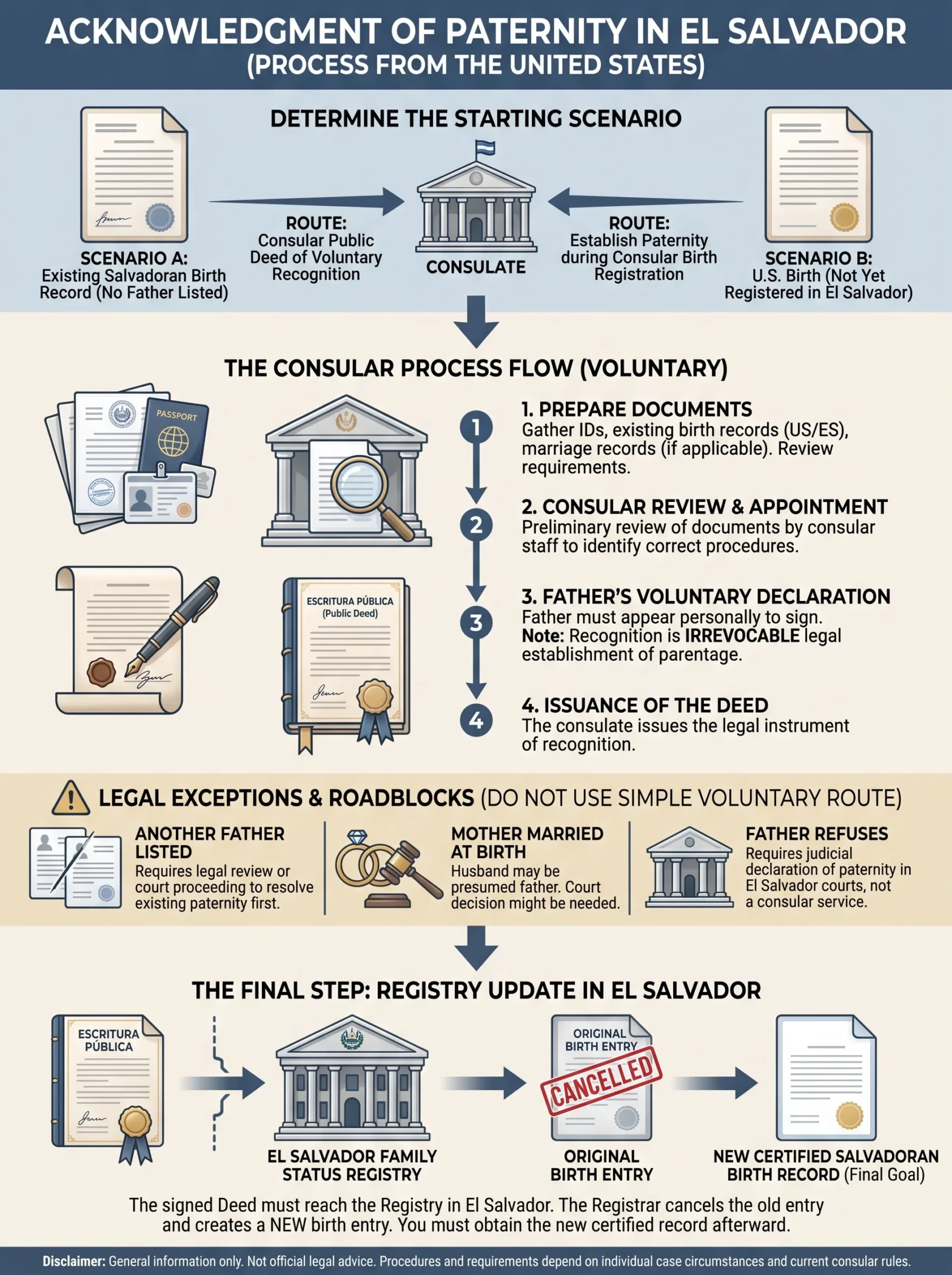
Paternity recognition in El Salvador can usually be started from the United States when the father voluntarily agrees to establish legal paternity. If the child already has a Salvadoran birth record without a father listed, the usual consular route is a public deed of voluntary recognition. If the U.S. birth has not yet been registered in El Salvador, paternity may be established during the consular birth registration. A different process applies when another person is already recorded as the legal father.
Official application route: Start through El Salvador’s Consular Appointment Portal.
Select Escrituras públicas when a Salvadoran birth record already exists without the father, or Registro del Estado Familiar when registering a U.S. birth in El Salvador. Both categories are available through the consular appointment system.
Choose the Route Based on the Birth Record
| Current Situation | Route to Request | Intended Result |
|---|---|---|
| The child was born in the United States and has not been registered in El Salvador | Registration of a birth that occurred abroad. If the father participates and the circumstances allow it, paternity may be established as part of the same procedure. | A first Salvadoran birth registration containing the legally recognized parental information. |
| A Salvadoran birth record exists, but no father is listed | Voluntary recognition, normally formalized through a consular public deed. | Registration of the recognition and issuance of a new Salvadoran birth entry. |
| Another person is already listed as the father | Legal review before requesting a deed. A paternity challenge or another family court proceeding may be required. | Resolve the existing legal paternity before recording another one. |
| The alleged father will not recognize the child | Provoked recognition or a judicial declaration of paternity, rather than a voluntary consular service. | Establish paternity through the appropriate Salvadoran family proceeding. |
El Salvador’s Family Code allows a father to recognize a child while providing information for the original birth registration, through an act before the Procuraduría General de la República, in a public deed, in a will or during a judicial proceeding. It also states that voluntary recognition of paternity is irrevocable. The consular declaration should therefore be treated as a legal establishment of parentage, not as a routine name correction.
Important: This page provides general information only. It is not an official government page and does not replace legal advice. Required documents, family attendance, consular fees and document delivery procedures may depend on the individual record and consular office. Confirm the conditions that apply to your case before taking action.
Documents to Prepare for Consular Review
The documents needed depend on whether the case involves a first Salvadoran birth registration, a later voluntary recognition or an existing paternity record. Before traveling to a consulate, gather the information related to the child’s current registration and confirm which items must be presented as originals, recent certifications or copies.
Documents and information to have available
- Certified copy of the child’s Salvadoran birth record, if one already exists.
- Certified U.S. birth certificate if the child was born in the United States.
- The recognizing father’s current DUI, passport or other identification accepted by the consular office.
- The child’s complete name, date and place of birth exactly as recorded.
- The adult child’s identification if it is required to confirm identity.
- The mother’s identification and birth record information when needed to identify the correct registration.
- Marriage, divorce or related court records when a marriage or prior legal paternity may affect the case.
- Copies of earlier recognitions, court decisions or birth records that could affect legal paternity.
Not every item is required in every case. Names, surnames, dates and places must match the existing records. A spelling difference, incorrect birth date or incorrect municipality can prevent the deed from being connected to the correct Salvadoran birth entry.
Documents Issued in the United States
If the child was born in the United States and has not yet been registered in El Salvador, the Family Status Registry process requires the foreign birth certificate in original form, original identification documents for both parents and certified birth records for both parents. Salvadoran parents should also confirm the permitted age of their Salvadoran birth certifications before the appointment.
Do not obtain an apostille automatically before knowing how a U.S. document will be used. A U.S. document that must produce legal effects through a separate Salvadoran procedure may have different authentication requirements from an instrument prepared directly by a Salvadoran consular officer. Ask whether an apostille or Spanish translation is required for the particular document being presented.
The U.S. birth certificate may be needed to:
- register the foreign birth in El Salvador;
- identify the child named in an existing Salvadoran record; or
- support preparation of a public deed of recognition.
How to Start the Process from the United States
- Obtain a current birth record. Check whether the paternal information is blank or whether another legal father is already identified.
- Select the appropriate service. Choose the Salvadoran consulate and look for “Escrituras públicas” or “Registro del Estado Familiar,” depending on the status of the birth registration.
- Request any preliminary review required by the office. The consular staff must accurately identify the father, child and Salvadoran record before preparing an instrument that will affect the registration.
- Appear before the consular officer. The father should be prepared to identify himself and personally declare his intention to recognize the child. A private letter or informal affidavit does not replace the Salvadoran legal instrument.
- Review the document before signing. Check every name, surname, date, registration number, book, page, municipality or district and the mother’s identifying information.
- Confirm how the deed will reach the family registry. Determine whether the consular office will transmit it or whether the certified instrument must be presented in El Salvador by the interested party or a representative.
Salvadoran consular officers have authority to perform certain notarial functions. The Notary Law allows diplomatic and consular officials who are legally authorized to prepare instruments intended to produce legal effects in El Salvador.
Questions to Ask Before the Appointment
- Should I schedule “Escritura pública” or “Registro del Estado Familiar”?
- Must only the father appear, or is the mother or child also required?
- How recently must the Salvadoran birth record have been issued?
- Does the U.S. birth certificate require an apostille or Spanish translation for this particular use?
- What consular fee applies to this instrument and which payment methods are accepted?
- Will the consulate transmit the deed, or must someone present it in El Salvador?
- How can the family obtain the new certified Salvadoran birth record afterward?
Confirm the fee for the specific service with the consular office before the appointment. The published US$40 fee for a power or mandate should not be used as the price of a paternity recognition deed because those are different legal instruments. Processing time can also vary because the case may involve preparation of the deed, transmission to El Salvador, registry review and issuance of a new birth record.
What Happens After the Recognition Is Signed
Signing the public deed does not by itself complete the visible update to the child’s Salvadoran birth record. The document establishing paternity must reach the appropriate Family Status Registrar and pass registry review.
Under the Family Status Registry Law, once the registrar receives the document establishing or recognizing paternity, the registrar must cancel the original birth entry through a marginal notation and create a new entry. The new birth entry does not state that it resulted from a later recognition, although the registry keeps the connection between the records.
The final document to obtain is therefore not merely a copy of the public deed. Request a certified copy of the new Salvadoran birth record and verify that:
- the father’s and child’s names are spelled correctly;
- the child’s surnames correspond to the new entry;
- the date and place of birth were not changed by mistake; and
- the certification belongs to the new entry rather than the canceled record.
Cases That Do Not Follow the Simple Voluntary Route
Another Father Is Already Listed
A second voluntary declaration does not automatically replace an existing legal father. El Salvador’s Family Code provides rules for cases in which an existing legal paternity conflicts with a later claim. Depending on how the first paternity was established, a court proceeding may be required before another paternity can take legal effect.
This issue may arise when:
- the mother was married when the child was born;
- Salvadoran law attributed paternity to the mother’s husband;
- another person previously recognized the child; or
- a U.S. or Salvadoran court has already entered a parentage decision.
In these situations, obtain guidance from the Procuraduría General de la República or a qualified Salvadoran family attorney before paying for or signing a new public deed.
The Alleged Father Does Not Agree
A consulate cannot turn the mother’s request into a voluntary acknowledgment signed on behalf of the father. When the alleged father does not voluntarily recognize the child, Salvadoran law provides procedures such as provoked recognition and judicial declaration of paternity. Biological evidence may be considered in those proceedings.
El Salvador’s Ministry of Foreign Affairs and the Procuraduría General de la República coordinate certain family services for Salvadorans abroad, including requests involving voluntary recognition of a son or daughter abroad. Families in the United States may use the Salvadoran diplomatic and consular network to determine where the appropriate procedure should begin.
Recognition of an Adult Child
Turning 18 does not by itself eliminate the possibility of voluntary recognition. Whether the process can proceed depends on the existing parentage record and the legal circumstances of the recognition. The consular office may request identification or other records from the adult child to confirm identity and prevent inconsistencies.
Do not assume that the adult child’s absence will always be accepted. Confirm whether the person being recognized must appear or provide additional documentation in that particular case.
Whether DNA Testing Is Required
The Family Code does not list DNA testing as a general requirement for a voluntary public deed of recognition. Biological testing becomes more relevant when paternity is disputed, the alleged father refuses recognition or the matter is presented to a family court.
A private DNA report does not by itself amend a Salvadoran birth record. The appropriate recognition, administrative action or court decision must still be entered into the Salvadoran registry.
The Mother Was Married When the Child Was Born
This fact should be disclosed before a consular instrument is prepared. Salvadoran law contains presumptions of paternity connected with marriage. If another man is treated as the legal father under those rules, a different paternity generally cannot simply be added through a new voluntary declaration without first addressing the existing legal relationship.
When the Child Was Born in the United States
If the U.S. birth has not yet been registered in El Salvador, the birth may be registered through the Registro del Estado Familiar at a Salvadoran diplomatic or consular representation. The registration process requires the original foreign birth certificate, original identification documents for both parents and certified birth records for both parents.
Review the U.S. birth certificate before selecting a consular service. If the certificate already identifies the father, present it with the other registration documents so the consular registrar can determine how the parental information should appear in the Salvadoran entry. If no father appears and the father will participate in establishing paternity during the first Salvadoran registration, the consular office can indicate the form required for that situation.
| Document | What It Does | What It Does Not Do |
|---|---|---|
| U.S. birth certificate | Documents the birth registered in the state where it occurred. | It does not automatically update an existing Salvadoran birth record. |
| Public deed of recognition | Records the father’s formal declaration of paternity when later recognition is required. | It is not the final certified Salvadoran birth record. |
| Salvadoran birth record | Shows how the birth and parentage are officially registered in El Salvador. | An older canceled entry should not be used in place of the new registration. |
Documents That May Need to Be Updated
Other Salvadoran documents do not change automatically after the new birth entry is created. If the recognition changes the recorded surnames or paternal information, the family may need to review the child’s:
- Salvadoran DUI;
- Salvadoran passport;
- school or university records;
- family, inheritance or benefit records; and
- U.S. documents, following the rules of the issuing state or federal agency.
For a DUI data modification based on later paternity recognition, the Salvadoran DUI service requires a new birth record issued after the recognition. The public deed alone does not replace the updated birth certification for that change.
Official Sources
- Family Code of El Salvador — Contains the legal rules governing paternity, voluntary recognition, provoked recognition, judicial declaration and challenges to existing paternity.
- Ministry of Foreign Affairs — Consular Appointment Portal — Lists public deeds, notarial acts and Family Status Registry matters among the services available through the consular appointment system.
- Ministry of Foreign Affairs — Family Status Registry — Lists the documents required to register a birth that occurred abroad and explains how Salvadorans outside the country can use diplomatic or consular representations for registration.
- Ministry of Foreign Affairs — Coordination With the Procuraduría General de la República — Identifies voluntary recognition of sons and daughters abroad among the family matters handled through institutional coordination.
- Ministry of Foreign Affairs — Public Instruments Executed Abroad — Describes consular notarial services and the published fees for powers, mandates and wills.
- Notary Law of El Salvador — Regulates notarial acts performed by authorized Salvadoran diplomatic and consular officials.
- Family Status Registry Law — Regulates registry changes following recognition of paternity or maternity, including creation of a new birth entry.
- Ministry of Foreign Affairs — DUI Abroad — Requires a newly issued birth record as supporting documentation when DUI data are changed after a later paternity recognition.