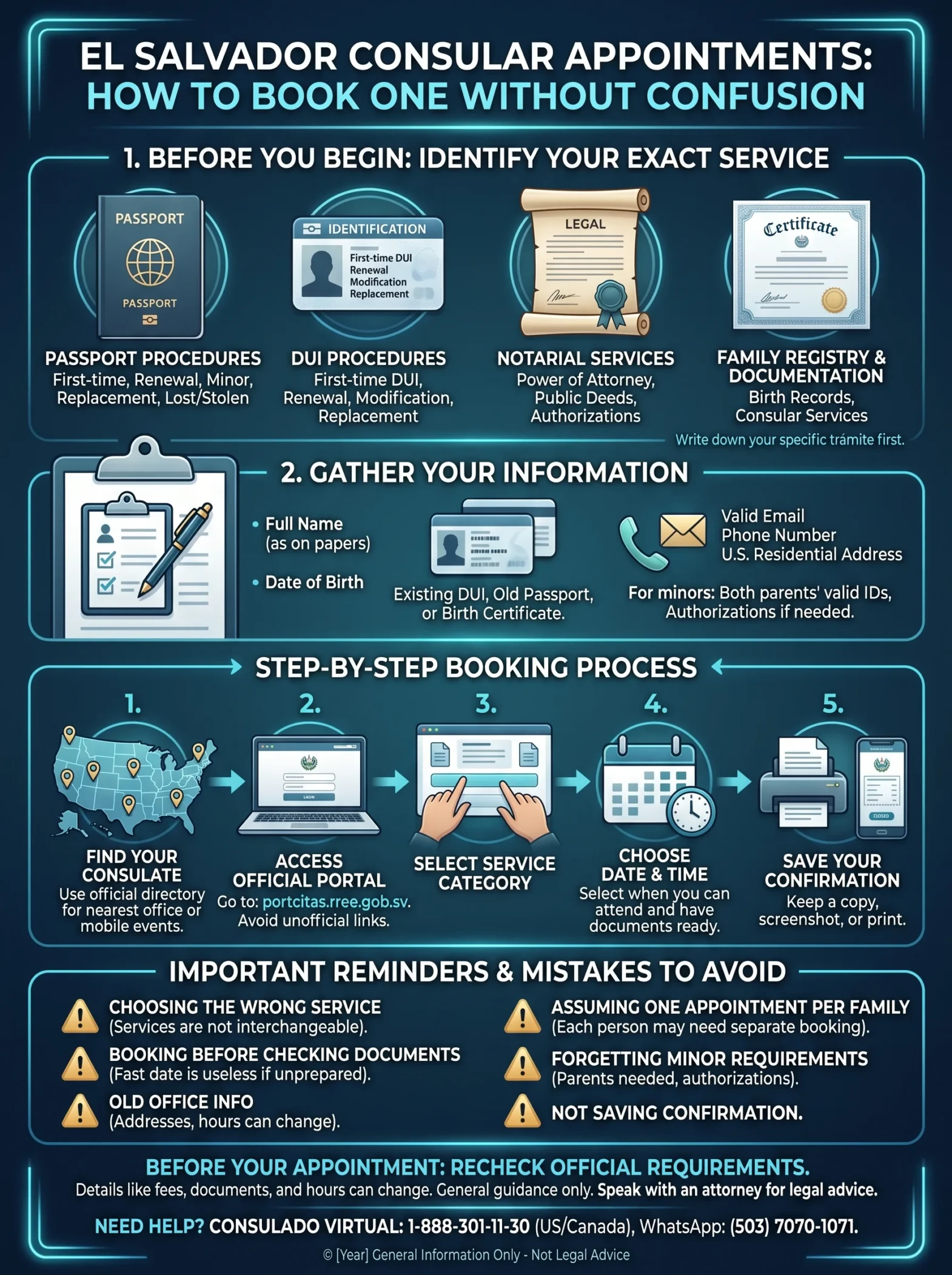
Searching for an available date first can lead you to book the wrong appointment. For El Salvador consular services, it matters whether you need a first-time application, renewal, replacement, registration, authorization, or notarial service, as well as who the appointment is for. The Ministry of Foreign Affairs appointment portal covers services such as passports, public instruments, notarial acts, Family Registry matters, documentation, visas and immigration services, and DUI procedures.[1] Some procedures that previously required a trip to a consular office now also have another option; the clearest example in the United States is DUI renewal and replacement.
Before looking for a date, identify the appointment you actually need
Do not start with the calendar. First describe your situation precisely enough to identify the correct service. “I need a passport” or “I need to do something with my DUI” may be too general to choose the right appointment.
| What you need | What to distinguish | Confusion to avoid |
|---|---|---|
| Passport | First issuance, renewal, or replacement; adult or minor. | Choosing renewal when the passport was lost or stolen. |
| DUI | First issuance, renewal, replacement, or another change. | Booking an in-person appointment in the U.S. for a renewal or replacement that can be completed online. |
| Family Registry | Birth, marriage, death, or another event that needs to be registered. | Looking for a generic “documents” appointment without identifying the registration involved. |
| Power of attorney or notarial act | Which instrument you need and what it will be used for. | Requesting simply “a power of attorney” without knowing its purpose. |
| Procedure for a minor | Whether it involves a passport, an authorization related to the minor, or another service. | Treating every procedure involving a child or teenager as the same type of appointment. |
Salvadoran embassies and consulates provide services that include DUI processing, ordinary passports, authorizations for children and adolescents, Family Registry matters, and public instruments executed abroad.[3] The fact that two services may be available at the same consular office does not mean they use the same type of appointment.
How to make a consular appointment without getting lost in the process
Start from the official Ministry of Foreign Affairs access point
The appointment system linked by El Salvador’s Ministry of Foreign Affairs is available at portalcitas.rree.gob.sv. If you reach the system through an internet search, check the domain before entering personal information. You do not need to pay a third party to access the portal or look for appointment availability.
Before opening the calendar: know who will complete the procedure, which document or service is needed, whether it is a first issuance, renewal, or replacement when that distinction applies, and which consular office you plan to use.
Check the consular office before choosing a time
Do not choose a location only because it is the first city showing an available date. The office must be a valid location for the service you need and somewhere you can realistically attend. If you are considering traveling to another state because appointments are available there, first determine whether that office handles your specific procedure.
This avoids ending up with an appointment that is valid in the system but not useful for your case.
Choose the exact service and situation
The same type of document can involve different procedures. Official passport information for Salvadorans abroad, for example, separates first issuance, renewal, and replacement for both adults and minors.[4]
- Expired or soon-to-expire passport: this generally points to a renewal.
- Lost or stolen passport: review the replacement rules rather than assuming it is a renewal.
- Passport for a minor: preparation may depend on whether both parents are present or whether an authorization is needed because one parent cannot attend.
- Power of attorney: you should know what you intend to authorize. The Ministry of Foreign Affairs notes that powers of attorney can serve different purposes and that, at most consulates, an appointment is required to explain what type of power is needed.[7]
Identifying the correct procedure matters more than finding an appointment quickly.
Review the requirements before committing to a date
Before booking, make sure you will be able to gather the documents required for your situation. You do not need to turn the appointment search into a full review of every requirement, but you should identify any condition that could change how the procedure is handled: whether it is for a minor, whether one parent will be absent, whether a document was lost, whether there are name or civil-status changes, or whether the service has an online option.
This also helps you choose a realistic appointment date. If you still need to obtain a certification, authorization, or update another document first, an appointment that is too soon may not be useful.
Check the office, service, date, and person before confirming
When the system shows availability, check at least four details before finishing: consular office, selected service, person who will be served, and appointment date and time. If the portal generates a confirmation or receipt, keep it with your appointment information.
Do not rely only on remembering “Tuesday morning.” The exact name of the service you selected can matter just as much as the time.
An available date does not prove that you selected the right appointment
You lost your passport
Finding an opening under “renewal” does not turn the case into a renewal. First determine whether a replacement is required.
You want to renew your DUI
If you live in the United States, check the online option for renewal and replacement before looking for an in-person appointment.
The procedure is for your child
An adult passport option is not appropriate simply because it has availability. Procedures for minors have their own conditions.
Availability only tells you that there is space on the calendar. It does not verify whether the service you selected matches your situation.
DUI in the United States: renewal and replacement now have an online option
Since July 17, 2026, Salvadorans living in the United States have been able to renew or replace their DUI through dui.sv/exterior. The official announcement from El Salvador’s Ministry of Foreign Affairs states that the process can be completed from a mobile phone or tablet by creating an account and following the steps on the platform. First-time DUI issuance continues to be handled in person at the 18 service centers operating at Salvadoran consular offices in the United States.[2]
If your procedure involves a DUI, separate these situations:
- Renewal in the United States: check the online option first.
- Replacement in the United States: check the online option first.
- First issuance: it remains an in-person procedure.
- Modification or another situation: do not assume it is covered by the announcement for renewals and replacements; identify the procedure that applies to your case.
This distinction can prevent you from booking an appointment and traveling to a consulate for a procedure that can instead be completed through the digital service identified by the RNPN and the Ministry of Foreign Affairs.
“Immediate issuance” does not automatically mean “no appointment”
Another term that can cause confusion is immediate DUI issuance. On August 8, 2026, the Ministry of Foreign Affairs announced an expansion of this service at Salvadoran offices in the United States: the announcement confirmed the service in Chicago, Aurora, and Charlotte and stated that Springdale and Doral would be added during the following days.[5]
That announcement refers to how the document is issued. It should not, by itself, be interpreted as meaning that anyone can arrive without an appointment. To determine how to receive service, follow the specific instructions for the consular office or special service event involved.
Regular appointments, special service days, and mobile consulates may use different rules
The Ministry of Foreign Affairs appointment portal states that it also provides information about mobile consulates and special consular service days. Do not automatically assume that these events follow the same process as an ordinary appointment.
| Type of service | What to check |
|---|---|
| Regular appointment | Office, service, date, time, and requirements for your procedure. |
| Special service day | Which procedures are offered, the location, hours, and whether an appointment or another service system is used. |
| Mobile consulate | Services offered at the event, temporary location, and the specific method of receiving service. |
There are official examples of mobile consulates in the United States operating on a first-come, first-served basis without an appointment. For example, the Ministry of Foreign Affairs announced that arrangement for a mobile service day organized by the Consulate General of El Salvador in Omaha in Grand Island, Nebraska.[6] That does not mean every mobile consulate works the same way. The instructions published for each individual event are the ones that apply.
What to do when the calendar shows no available appointments
A lack of available dates is not always solved by searching more cities. Check the situation in this order:
- Check the service: make sure you are searching within the correct category.
- Check for another service method: a DUI renewal or replacement from the United States, for example, may use the online option.
- Consider another consular office only if it handles your procedure: an open appointment in another city is not useful if that office does not provide the service you need.
- Check special service days and mobile consulates: they may bring certain services to other cities, but you need to read the conditions for that specific event.
- Avoid making several reservations for the same procedure: if you obtain a valid appointment and later need to change it, review the system’s options for correcting or rescheduling it instead of accumulating appointments.
Do not confuse a lack of availability with a need to pay an intermediary. Start with official channels. Do not give personal information or money to someone claiming to have access to reserved appointments outside the official system.
If you already booked and discover that something is wrong
Not every booking error has the same consequence. First identify what needs to be corrected:
- you selected a different consular office;
- you chose renewal when replacement was required;
- the appointment was made for another person;
- the date no longer works for you;
- you noticed incorrect information;
- you discovered that your procedure uses another service method.
Review the options shown with your reservation or in the appointment portal to modify, cancel, or reschedule when available. If the system does not provide a clear solution, use an official contact channel and explain specifically which service you booked and what needs to be changed. Do not assume that consular staff will be able to convert an appointment for one procedure into a different type of appointment after you arrive.
If several family members are going, separate each person and procedure
Going to the consulate together does not turn several family procedures into one appointment. A mother may need to renew a passport, a child may need a minor’s passport, and another relative may need a first-time DUI. Each case can have different requirements and a different method of receiving service.
For each person, identify:
- full name;
- service they will complete;
- first issuance, renewal, replacement, or another variation, when applicable;
- consular office;
- appointment date and time, when required;
- documents prepared for that person.
Do not assume that one appointment automatically covers several family members. Follow what the system requires for each person and each service.
Your final check should cover both the appointment and the procedure
Before leaving for the consulate, review two sets of information separately. This is particularly useful when the consular office is far from your home.
Your appointment
- correct consular office;
- address;
- date and time;
- service name;
- person listed on the appointment;
- saved confirmation.
Your procedure
- correct type or variation;
- required original documents;
- copies when applicable;
- presence of parents or other people when required;
- applicable authorizations;
- payment method for the procedure, when applicable.
An appointment only reserves or determines the method of receiving service. It does not replace the requirements for the underlying procedure. When the office, person, service, and documentation all match, you reduce the chance that a valid reservation turns into a consular visit that does not resolve what you came to do.
This content is an independent informational resource and does not represent El Salvador’s Ministry of Foreign Affairs, the RNPN, or any consular office. For an official procedure, the instructions issued by the appropriate authority take precedence.
Official Sources
- [1] Appointment Portal — Ministry of Foreign Affairs of El Salvador — Describes the appointment portal, the types of services that can be scheduled, and information about mobile consulates and special service days.
- [2] Online DUI Renewal and Replacement for Salvadorans in the United States — Ministry of Foreign Affairs — Official publication dated July 17, 2026, confirming the online renewal and replacement option through dui.sv/exterior while keeping first-time issuance in person.
- [3] Services Provided by Salvadoran Embassies and Consulates Abroad — Ministry of Foreign Affairs — Lists major consular services, including DUI, passports, authorizations for minors, Family Registry services, and public instruments.
- [4] Ordinary Passports for Salvadorans Abroad — Ministry of Foreign Affairs — Separates first issuance, renewal, and replacement procedures for adults and minors, showing why the specific case should be identified before booking.
- [5] Expansion of Immediate DUI Issuance in the United States — Ministry of Foreign Affairs — Official publication dated August 8, 2026, describing the expansion of immediate DUI issuance at Salvadoran offices in the United States.
- [6] Mobile Consular Service in Grand Island — Ministry of Foreign Affairs — An official example of a mobile service day organized on a first-come, first-served basis without prior appointments, illustrating how these events can differ from regular appointments.
- [7] Notarial Acts — Ministry of Foreign Affairs — Explains that powers of attorney may serve different purposes and that requirements depend on the type of instrument requested.