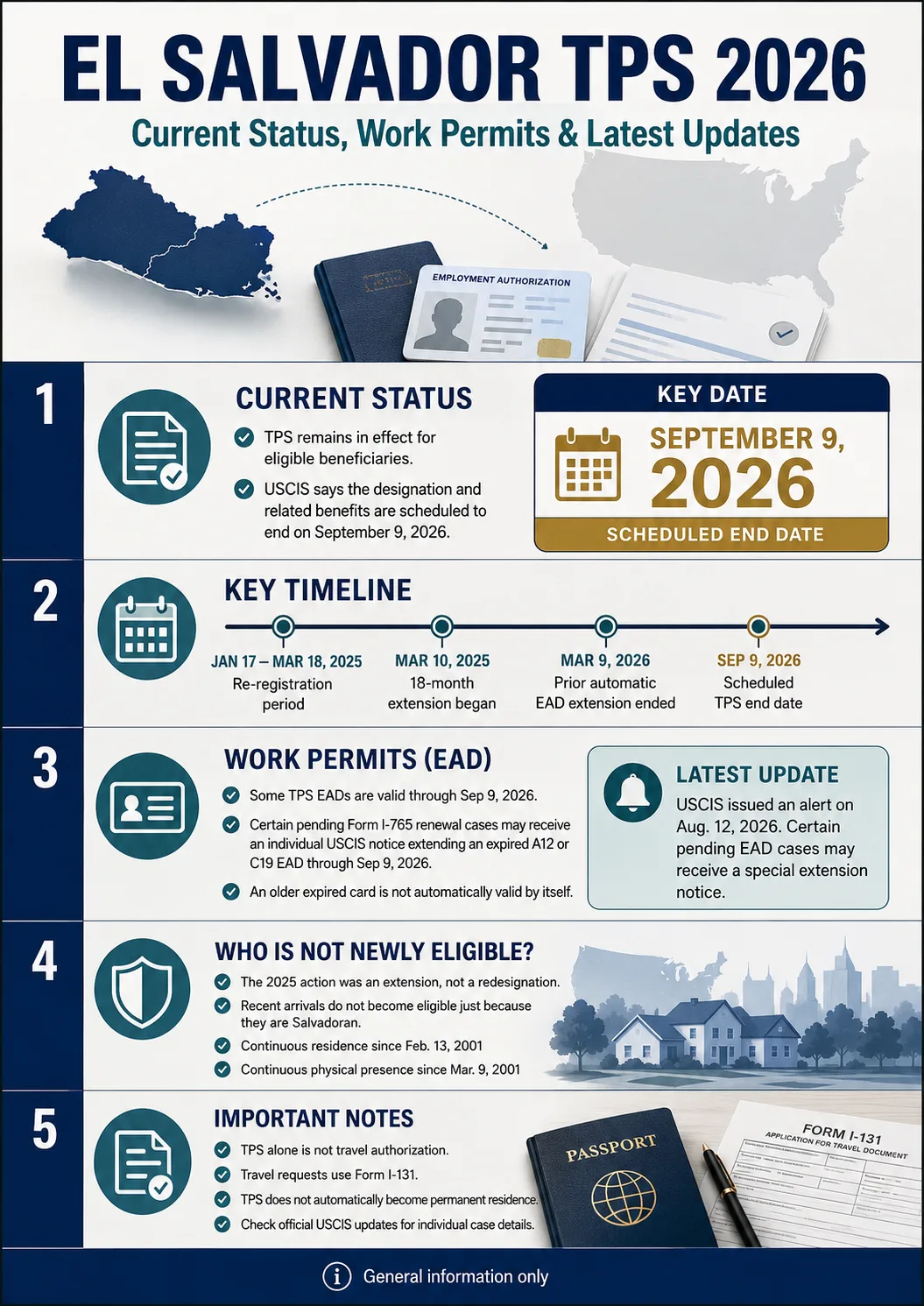
September 9, 2026 has passed, but El Salvador TPS beneficiaries have not automatically lost TPS protection or employment authorization. USCIS states that an announcement on El Salvador’s Temporary Protected Status will be made at the appropriate time and that, until then, Salvadoran individuals present in the United States under TPS retain protection, including work authorization. As of October 3, 2026, DHS has not announced a new fixed end date or a new 6-, 12-, or 18-month extension period.
Continues pending a further DHS announcement
Previous designation end date has passed
None announced as of October 3, 2026
USCIS says beneficiaries retain it pending the announcement
This page is an independent informational resource and provides general information only. It is not a communication from USCIS, DHS, or a Salvadoran consulate, and it does not replace legal advice about an individual immigration case.
What changed after September 9, 2026
The TPS period announced in January 2025 ran from March 10, 2025 through September 9, 2026. Existing beneficiaries were instructed to re-register between January 17 and March 18, 2025. Before September arrived, USCIS also published instructions concerning certain TPS-based EAD applications and documents that were being extended through September 9.
The situation changed before that date could operate as an automatic cutoff. USCIS subsequently posted an alert stating that a further announcement concerning El Salvador TPS would be made at the appropriate time. The agency says that until that announcement is made, Salvadoran individuals present in the United States under TPS retain protection, including work authorization.
September 9 has therefore become a past date from the prior TPS period, not a current fixed termination date that can be used by itself to determine whether an existing Salvadoran beneficiary still has TPS protection. DHS has not announced a replacement termination date, and the current USCIS notice should not be described as a formal new 18-month extension unless DHS later publishes such an action.
Before September 9, the main question was what would happen when the announced TPS period reached that date. After September 9, USCIS is expressly allowing current Salvadoran TPS protection and work authorization to continue while a further DHS announcement is pending. The length of that interim period has not been given a fixed end date.
What the current notice means for work authorization
USCIS expressly includes work authorization in the protection that continues while the El Salvador TPS announcement remains pending. That is different from saying that every physical Employment Authorization Document has received a newly printed expiration date.
TPS-based EADs commonly use category A12 or C19. A beneficiary may also have an expired physical card, a pending Form I-765, a Form I-797 notice, or an individual extension notice. These documents should not be treated as interchangeable. The current USCIS alert establishes that qualifying Salvadoran TPS beneficiaries retain employment authorization, but the documentation used to prove that authorization for Form I-9 purposes must follow the most recent USCIS and I-9 Central instructions.
| Situation | What to check now |
|---|---|
| EAD showing September 9, 2026 | The printed date has passed. USCIS nevertheless states that Salvadoran TPS beneficiaries retain work authorization pending a further announcement. Check current I-9 Central instructions for the documents used to prove that authorization. |
| Older EAD covered by the 2025 Federal Register extension | The general extension in that notice ran through March 9, 2026. The older Federal Register extension by itself is not the current basis for post-September 9 employment authorization. |
| Special USCIS notice extending an EAD through September 9, 2026 | The date stated in that individual extension has passed. Keep the notice, but use the current USCIS and I-9 Central guidance when determining documentation after September 9. |
| Form I-765 renewal still pending | Check the EAD category, receipt and approval notices, your myUSCIS account, and any later notice issued by USCIS. A pending application and proof of current employment authorization are not automatically the same thing. |
| Employer asks whether TPS ended on September 9 | USCIS currently states that Salvadoran individuals under TPS retain protection, including work authorization, until a further announcement is made. |
What happened to cards previously extended through March 2026
The Federal Register notice published in January 2025 automatically extended certain El Salvador TPS EADs in categories A12 or C19 through March 9, 2026. That general extension has already reached its end date.
USCIS later sent notices to certain beneficiaries with pending TPS-based EAD renewals that allowed an expired EAD to be used with the notice as evidence of employment authorization through September 9, 2026. That date has also passed. The current USCIS alert is broader in one respect: it states that Salvadoran individuals under TPS retain protection including work authorization until DHS makes its further announcement.
If your Form I-765 is still pending
A pending TPS-based Form I-765 should still be tracked through USCIS. Check postal mail and your myUSCIS account for an approval, Request for Evidence, individual extension notice, or other case action.
Older USCIS materials discussed automatic EAD extensions of up to 540 days for certain timely filed renewal applications, subject to the rules and limits that applied at the time. USCIS later changed its guidance following changes in federal law. Do not calculate current employment authorization solely by adding 540 days to an old expiration date or by relying on an old Form I-797C statement without checking current instructions.
The current El Salvador alert provides a separate and more recent point: Salvadoran individuals present in the United States under TPS retain work authorization until the pending TPS announcement is made.
Form I-9 after September 9, 2026
Before September 9, USCIS had instructed certain workers with pending TPS-based EAD renewals to present an expired qualifying EAD together with an individual USCIS extension notice as List A documentation through September 9, 2026. Employers were instructed to use that date for those cases.
Those instructions contained a date that has now passed. USCIS I-9 Central currently carries the newer El Salvador TPS alert stating that Salvadoran individuals under TPS retain protection, including work authorization, while DHS prepares a further announcement. The alert does not announce a new fixed employment-authorization expiration date.
The USCIS position after that date should also be considered. September 9 should not be treated as an automatic loss of work authorization for a Salvadoran beneficiary who remains protected by the current TPS alert. For the documentation and Form I-9 procedure to use, consult the current I-9 Central instructions and any USCIS notice issued to the employee.
An employer does not decide whether DHS continues or terminates a TPS designation. The employer’s role is to complete employment eligibility verification under Form I-9 rules. The worker’s actual USCIS documents and the agency’s current I-9 guidance are therefore more useful than relying on an expiration date that belonged to the prior TPS period.
The regular re-registration period has closed
For the 2025–2026 extension, existing beneficiaries were required to re-register between January 17 and March 18, 2025. The current continuation of protection while DHS considers its next action has not been announced as a new general re-registration period.
If a person who already had TPS did not re-register during the designated period, USCIS allows late re-registration when the applicant can show good cause for filing after the deadline. This is different from an automatic reopening of the registration period.
Someone who missed the 2025 re-registration period should therefore not assume that the present TPS alert creates a new deadline. USCIS can examine the reason for a late filing and the individual eligibility requirements.
Recent arrival in the United States does not open eligibility for this TPS designation
El Salvador TPS remains based on the designation that began in 2001. The country-specific USCIS information lists continuous residence in the United States since February 13, 2001 and continuous physical presence since March 9, 2001 as the applicable dates.
This means that someone who arrived in the United States in 2020 or 2024, for example, cannot obtain this TPS designation solely because they are Salvadoran. The 2025 action was an extension of the existing designation, not a redesignation with newer residence and physical-presence dates.
There is a process known as late initial registration, but it is not an open registration period for people who arrived after the required dates. It has separate regulatory requirements and should also be distinguished from late re-registration by a person who was already a TPS beneficiary.
What happens if Form I-821 or Form I-765 is still pending
The January 2025 Federal Register notice stated that a person who already had a pending El Salvador TPS application, Form I-821, as of January 17, 2025 did not need to file another Form I-821 solely because of the 2025 extension. Similar instructions applied to certain pending Form I-765 applications.
September 9, 2026 has now passed, so statements in the 2025 notice that were tied specifically to the end of that designation period should be read together with the newer USCIS alert. USCIS currently says Salvadoran individuals present in the United States under TPS retain protection, including work authorization, until a further announcement.
If Form I-765 remains pending, continue checking myUSCIS and postal mail for case-specific notices. A pending application should not, by itself, be treated as proof of every immigration benefit. The beneficiary’s TPS history, current USCIS protection, EAD category and individual notices may all matter.
What September 9, 2026 means now
September 9, 2026 was the final date of the 18-month TPS extension announced in the January 2025 Federal Register notice. It is no longer accurate to describe that date as an approaching termination date.
USCIS has not announced that Salvadoran beneficiaries automatically lost TPS on September 10. Instead, the agency says protection and employment authorization remain in place while DHS prepares a further announcement. No new fixed end date had been announced as of October 3, 2026.
This interim situation should also not be described as a formal 18-month renewal. A formal extension, termination or other new designation action would require an additional DHS announcement and, where applicable, the related official notice.
Having TPS for many years does not automatically convert that protection into a Green Card. At the same time, any future change to TPS does not automatically decide a separate family petition, asylum case, adjustment-of-status application, court matter, or employment authorization issued under another category.
It is also necessary to distinguish between having a pending application and having a particular immigration status or employment authorization. Different applications provide different protections, and the effect of another pending immigration matter depends on the law governing that process.
Congressional developments involving El Salvador TPS
H.R. 10297, the El Salvador TPS Act of 2026, was introduced in the U.S. House of Representatives on September 3, 2026 and referred to the House Committee on the Judiciary. The introduced bill would require the Secretary of Homeland Security to designate El Salvador for TPS until 18 months after September 9, 2026.
The proposal is a bill, not current law. Its introduction does not itself extend El Salvador TPS, change the expiration date on an EAD, or replace DHS and USCIS instructions. The U.S. Government Publishing Office lists September 3, 2026 as the latest action date for the introduced version.
Travel while the DHS decision is pending
TPS by itself does not function as authorization to leave the United States and return. USCIS allows TPS beneficiaries and certain applicants with a pending Form I-821 to request travel authorization using Form I-131. Approval is discretionary, and the travel document applies for the period and conditions stated by USCIS.
The lack of a new fixed TPS end date does not eliminate the need to evaluate travel carefully. TPS protection, a travel authorization document, and admission to the United States are separate matters. A person with a removal order, periods of unlawful presence, a complicated immigration history, or another pending proceeding may need case-specific legal advice before departing the United States.
Situations that depend on individual documents
Some cases cannot be resolved simply by knowing that USCIS currently continues El Salvador TPS protection. Individual documents and immigration history may change the answer, including when:
- an EAD has expired and it is unclear what document can be used for Form I-9 after September 9;
- Form I-765 remains pending and an expected USCIS notice has not arrived;
- an employer requests reverification based solely on the old September 9 date;
- the person did not re-register during the January–March 2025 period;
- there is an Immigration Court case or an existing removal order;
- the person also has an asylum case, adjustment-of-status application, family petition, or another immigration process;
- the person plans to travel outside the United States while the DHS TPS decision remains pending; or
- an arrest, conviction, or another event may affect individual TPS eligibility.
In these situations, the TPS approval history, EAD category, USCIS notices, filing dates and any other immigration status or proceeding can affect the result. Current Salvadoran TPS protection does not erase separate eligibility requirements that apply to an individual case.
Official Sources
- USCIS — Temporary Protected Status Designated Country: El Salvador — Contains the current El Salvador TPS alert stating that beneficiaries retain TPS protection, including work authorization, until a further announcement is made.
- USCIS — I-9 Central — Carries the current El Salvador TPS alert for employment-verification purposes and provides Form I-9 guidance for employers and workers.
- Federal Register — Extension of the Designation of El Salvador for Temporary Protected Status — Established the March 10, 2025 through September 9, 2026 extension, the January 17–March 18, 2025 re-registration period, and the EAD rules announced for that TPS period.
- USCIS — August 2026 El Salvador TPS Employment Authorization Update — Provides the earlier instructions for individual EAD extension notices that ran through September 9, 2026 and explains the related Form I-9 documentation.
- USCIS — Temporary Protected Status — Provides general TPS rules, including re-registration, late filing information and employment authorization guidance.
- USCIS — Form I-131, Application for Travel Documents, Parole Documents, and Arrival/Departure Records — Provides the official filing information for TPS-related travel authorization requests.
- U.S. Government Publishing Office — H.R. 10297, El Salvador TPS Act of 2026 — Contains the introduced bill text, its September 3, 2026 introduction and referral to the House Committee on the Judiciary. The proposal has not itself changed the current TPS rules.