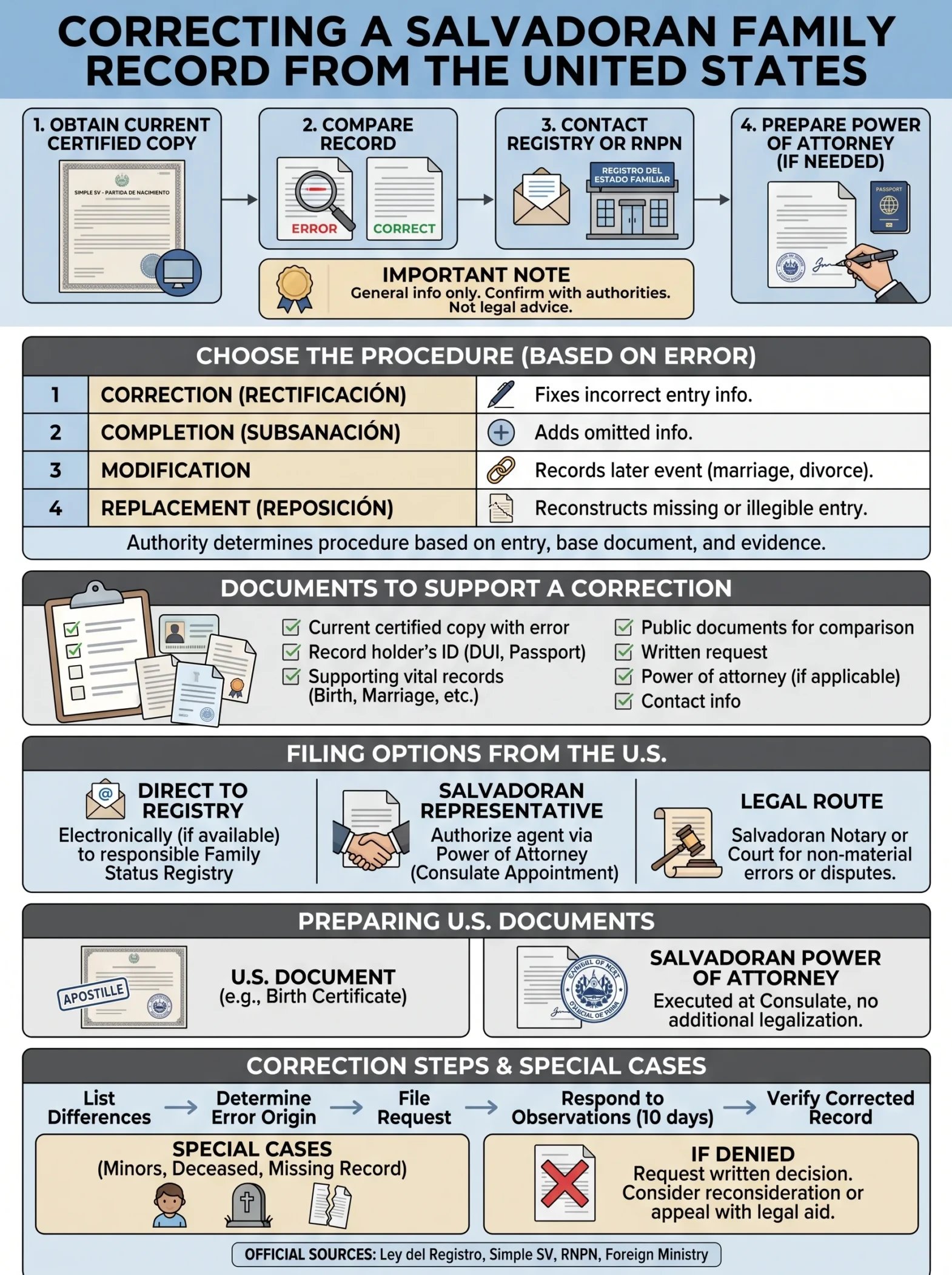
To correct a Salvadoran family record from the United States, first obtain a current certified copy of the record, identify where it was registered, and determine whether the problem is a material error or requires a more formal decision. Clear clerical errors may be corrected by the responsible Family Status Registry. If you cannot travel to El Salvador, an authorized representative may handle the application. A Salvadoran consulate can prepare the power of attorney, but it does not usually replace the registry, RNPN, Salvadoran notary, or court responsible for approving the correction.
Start with these four steps:
- Request a current certified copy of the record through Simple SV.
- Compare the record with public documents showing the correct information.
- Contact the Family Status Registry holding the record or the RNPN assistance system.
- If someone will act for you in El Salvador, prepare a power of attorney containing specific authority for the correction.
Choose the Procedure That Matches the Error
Salvadoran law distinguishes between correction, completion of an omission, modification, and replacement of a record. Choosing the wrong procedure can delay the application.
- Correction or rectificación: Fixes information entered incorrectly when the event was registered.
- Completion or subsanación: Adds information omitted from the original entry.
- Modification: Records a later event that changes a person’s family status, such as a recognition, marriage, or divorce.
- Replacement or reposición: Reconstructs an entry that is missing, destroyed, deteriorated, unsigned, or illegible.
| Situation | Likely Starting Procedure | Possible Authority |
|---|---|---|
| A first or last name was copied incorrectly | Administrative correction when the correct wording can be established from public documents. | Responsible Family Status Registry. |
| A name or last name was omitted or reversed | Administrative correction or completion if public records prove the correct information. | Family Status Registry. |
| The error is apparent from the entry itself | Administrative correction of a manifest error. | Family Status Registry. |
| Parentage, identity, or family status is disputed | An RNPN decision, Salvadoran notarial proceeding for an adult, or court order may be required. | RNPN, Salvadoran notary, or court. |
| The record is missing, destroyed, or illegible | Replacement rather than correction. | Family Status Registry or RNPN. |
| A marriage, divorce, recognition, or later event is missing | Registration or modification based on the document proving the later event. | Corresponding Family Status Registry. |
Articles 39 through 41 of the current Family Status Registry Law allow registrars to correct material errors administratively regardless of who created the entry or how long ago it was registered. The law also permits the person named in the record, a legal representative, or an authorized agent to submit the request. Other corrections may require an RNPN administrative decision, a court order, or a notarial proceeding when the person concerned is an adult.[1]
Important: This page provides general information. It is not an official government page and does not replace legal advice. Confirm the requirements for your specific record with the Family Status Registry, RNPN, or the Salvadoran professional handling the case before sending original documents.
Obtain the Current Record Before Filing
Work from a complete and legible certified copy, not an old photograph or information appearing only on a Salvadoran DUI or passport. The certified record should allow you to identify the entry number, book, page, year, place of registration, marginal annotations, and exact wording that needs to be corrected.
Certified family records may be requested electronically through Simple SV. The official service lists a fee of US$5 for a certified record issued in El Salvador and US$35 for certification service in the exterior. It also states that the resulting certificate does not expire, although the agency receiving it may require a recently issued copy.[2]
If the entry cannot be located, differs from other official records, or does not contain enough information to establish the correct data, an RNPN historical Family Status Registry certification may help. RNPN identifies this service as useful for verifying information and supporting replacement, correction, administrative, or court proceedings.[3]
Documents Used to Support a Correction
There is no single document list for every correction. The evidence depends on the disputed information and why it appears differently. The file should establish both what the record currently says and what the correct information should be.
Documents commonly needed:
- A current certified copy of the record containing the error.
- A copy of the record holder’s DUI, Salvadoran passport, or other identification.
- Related birth, marriage, divorce, or death records supporting the correct information.
- Public documents allowing the registrar to compare names, dates, or places.
- A written request identifying the incorrect wording, requested correction, and supporting evidence.
- A power of attorney if another person will submit or manage the application.
- Contact information for receiving notices and the final decision.
For example, if the mother’s second last name is missing from a birth record, the request should normally include the mother’s certified birth record and any public document connected to the original entry. If the error appears in a marriage record, review the birth records of both spouses and the marriage instrument that led to the registration.
Three Ways to Handle the Process from the United States
Submit the Request to the Responsible Registry
The request should be directed to the Family Status Registry responsible for the entry. The certified record usually identifies where the birth, marriage, death, or other family event was registered. Following El Salvador’s municipal restructuring, the responsible office may be the municipal registry or one of its district offices.
The law permits registries to receive requests and documents electronically. However, this does not mean that a nationwide online correction form is available for every municipality. Ask the registry or RNPN which official email address, form, or submission channel applies before transmitting personal records.
Authorize Someone in El Salvador
If the registry requires original documents, an in-person filing, or local follow-up, the record holder may appoint an agent. The power of attorney should identify the record and authorize the representative to:
- File the correction or completion request.
- Submit certified records and supporting evidence.
- Receive notices and respond to registry observations.
- File available administrative challenges if that authority is included.
- Request and collect the newly certified record after the correction is entered.
A consular appointment for a power of attorney or public instrument can be requested through the Foreign Ministry’s Consular Appointment Portal. The official service page requires identification from an individual granting a power or mandate and lists a consular fee of US$40.[4]
Take the representative’s full name and identification details, the registry’s location, a copy of the affected record, and a precise description of the requested action to the consular appointment. These details help the consular officer prepare authority that matches the actual proceeding.
Use a Salvadoran Notary or Court When Required
If the registrar determines that the problem is not a material error, the matter may require an RNPN decision, a Salvadoran notarial proceeding, or judicial action. The notarial route mentioned in the current law applies when the person concerned is an adult. Cases involving minors, disputed parentage, conflicting identity evidence, or facts requiring additional proof may need another procedure.
A Salvadoran professional should examine the record and supporting evidence before selecting the route. Avoid preparing a power that merely says “correct documents” without establishing whether the case is administrative, notarial, or judicial.
Preparing Documents Issued in the United States
A U.S. birth certificate, marriage certificate, court decision, or other public document may support the requested correction, but it must be prepared for official use in El Salvador. Because the United States and El Salvador participate in the Hague Apostille Convention, U.S. public documents are generally authenticated with an apostille from the appropriate authority.
A state document normally receives its apostille from the state that issued it. Federal documents follow the applicable federal authentication procedure. El Salvador’s Foreign Ministry explains that a properly apostilled document does not require additional legalization at a Salvadoran consulate. Ask the receiving registry whether a Spanish translation is also required for the particular document.[5]
A power of attorney executed directly before a Salvadoran consular officer follows the rules for consular instruments. It should not automatically be apostilled as though it were a document issued by a U.S. notary. The consulate can explain how the testimony or certified instrument will be delivered for use in El Salvador.
How the Correction Process Works
List Every Difference Separately
Prepare a simple comparison showing the information currently recorded, the requested wording, and the document proving it. Separate multiple errors instead of describing them together. This helps the registrar distinguish a clerical mistake from a change requiring another legal procedure.
Determine Where the Error Began
The authority will examine whether the registry copied a correct source document incorrectly or whether the source document already contained the disputed information. The first situation may qualify for administrative correction. The second may require correction of the source instrument or an RNPN, notarial, or judicial decision.
File an Identifiable Written Request
The application should state the applicant’s details, the capacity in which the person acts, the affected entry, the correction requested, the documents submitted, a method for receiving notices, and the applicant’s signature. Obtain a receipt or filing number that can be used to track the case.
Respond to Registry Observations
If the application or supporting instrument contains a correctable problem, the registrar must identify and explain it. The law provides 10 business days to correct an observation. Submit the requested item within that period and keep proof of delivery.
Request a New Certified Record
After approval and registration of the correction, obtain a new certified copy. Review all names, last names, dates, places, parent information, and marginal annotations. A correction is normally connected to the prior entry by an annotation; the original record is not informally erased or overwritten.
Cases That Require Additional Preparation
The Record Belongs to a Minor
A minor’s legal representative may request an administrative correction. If another person will act in El Salvador, the authority document should identify the parent or guardian, the child, and the specific application being authorized. The general notarial correction route described by the law is limited to cases in which the person concerned is an adult.
The Person Named in the Record Is Deceased
An administrative correction may be requested by relatives within the fourth degree of blood relationship or second degree by marriage, as well as heirs or beneficiaries under a will. The applicant should provide records establishing the relationship or legal capacity being claimed.
The DUI or Passport Shows Different Information
First determine which record contains the error. Correcting a birth record does not automatically update every Salvadoran identity document. After receiving the corrected certification, a separate update may be required through RNPN, a DUI service center, or the passport authority.
The Record Is Missing or Damaged
A missing record cannot be solved by requesting an ordinary correction. The registry must determine whether the case calls for a historical search, certification of no registration, replacement, or subsidiary establishment of family status. An RNPN historical certification may help locate information preserved in earlier identity and family record systems.
What to Do If the Application Is Denied
Request the written decision. It should identify the relevant facts and legal grounds. A verbal statement that the record “cannot be corrected” does not show whether evidence is missing, the office lacks jurisdiction, or another procedure must be used.
The Family Status Registry Law recognizes reconsideration and appeal. Reconsideration is optional and is decided by the same official who issued the decision. An appeal is directed to that official’s hierarchical superior. Because filing periods and procedural effects are also governed by Salvadoran administrative law, obtain Salvadoran legal assistance promptly after receiving a denial.
Official Sources
- [1] Ley del Registro del Estado Familiar — Articles 39 through 41 define corrections, completion of omissions, material errors, and the people authorized to apply. This is the legal text published by RNPN.
- [2] Certificación de partidas en Simple SV — This government service page lists the electronic application channel, required information, published fees, and certification options maintained by RNPN.
- [3] Certificación de registro histórico del Registro del Estado Familiar — RNPN explains how historical certification can support data verification, replacement, and correction proceedings.
- [4] Public Instruments Executed Abroad — El Salvador’s Foreign Ministry publishes the identification requirement and consular fee for powers and mandates granted by individuals abroad.
- [5] Authentications and Apostilles — The Foreign Ministry explains when foreign public documents require an apostille or another form of authentication before use in El Salvador.