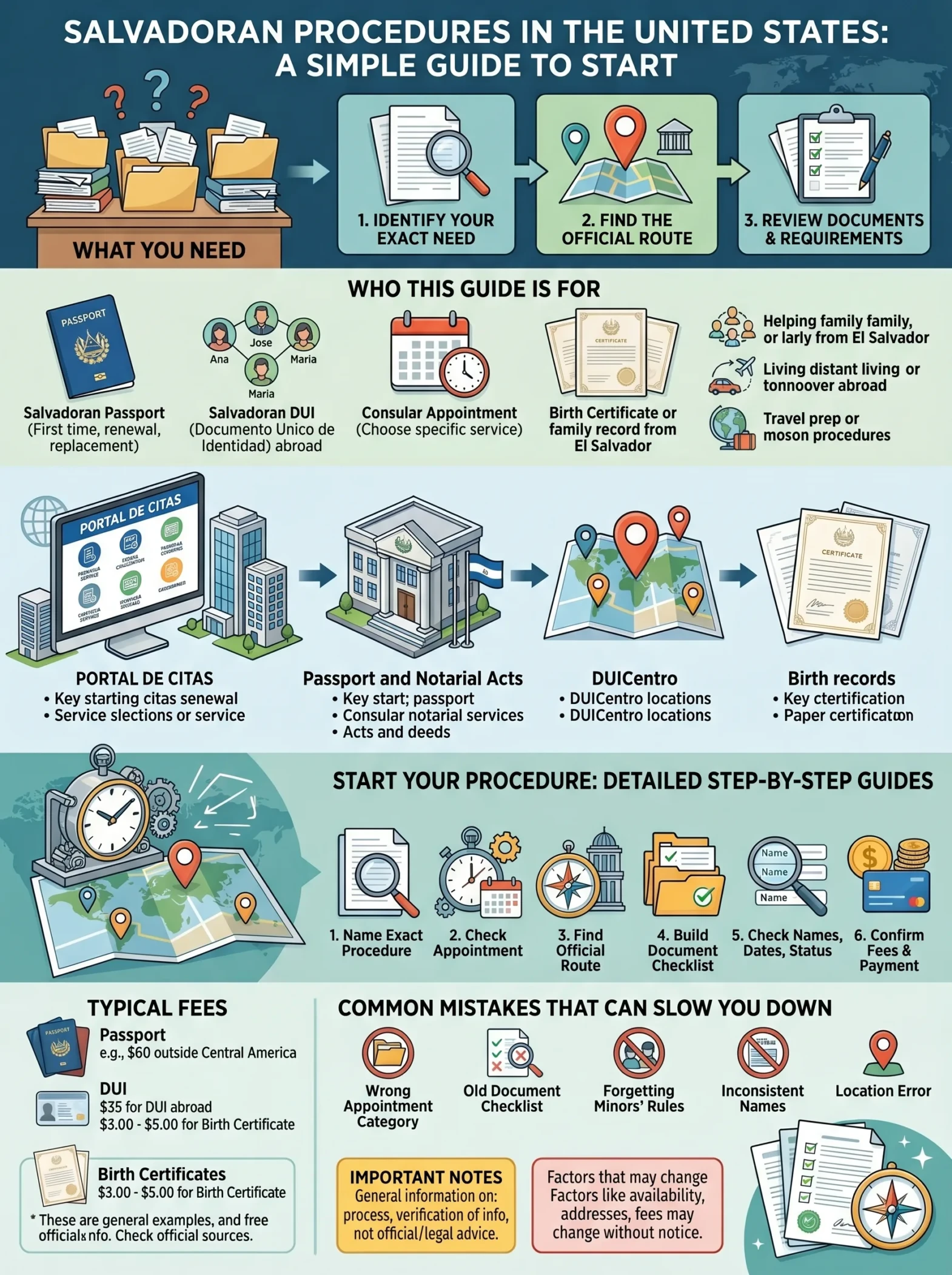
If you live in the United States and need to complete a Salvadoran procedure, searching for a consular appointment is not always the right first step. Start by identifying the result you need: traveling with a Salvadoran passport, obtaining or updating your DUI, requesting a certified copy of a record that already exists, registering in El Salvador a birth, marriage, or death that occurred in the United States, authorizing someone to act for you in El Salvador, or resolving differences between your documents. Each of these needs can lead to a different process.
The distinction may seem small, but it changes where you should begin. “I need a birth certificate” can mean requesting a certification of a birth that is already registered or registering for the first time a child born in the United States. “I need to renew my DUI” does not necessarily mean visiting a consulate either: DUI renewal and replacement from the United States now have an online option.
This is an independent informational guide. It does not replace instructions from El Salvador’s Ministry of Foreign Affairs, the RNPN, a Salvadoran consular office, or legal advice when a case requires determining legal effects in El Salvador.
Start with the result you need, not the name of the procedure
Before gathering documents, identify which of the following situations describes your case. Doing so can prevent you from preparing documents for a service that does not actually match your needs.
I need to travel
Determine whether you need a first passport, renewal, or replacement and whether the applicant is an adult or a minor.
I need my DUI
Separate first issuance, renewal, replacement, and data modification. They do not all follow the same process.
I need a civil record certificate
First determine whether the birth, marriage, or death is already registered in the Salvadoran system.
The event occurred in the United States
A birth, marriage, or death that occurred here may need to be registered in El Salvador’s Family Status Registry.
Someone needs to act for me in El Salvador
First identify exactly what that person will do; then the appropriate power of attorney or public instrument can be determined.
My documents show different information
Before renewing another document, identify which underlying record contains the information that needs to be corrected or updated.
The Ministry of Foreign Affairs appointment portal allows users to schedule services such as passports, public deeds, notarial instruments, Family Status Registry procedures, documentation services, and DUI-related procedures. The same portal also provides information about mobile consulates and special consular service days.[1] That does not mean every case should begin by booking an appointment.
Where each type of procedure generally begins
| What you need | What to clarify first | Likely starting point |
|---|---|---|
| Passport | First issuance, renewal, or replacement; adult or minor | Passport service at a Salvadoran consular office |
| DUI | First issuance, renewal, replacement, or modification | Online platform or service center, depending on the case |
| Birth, marriage, or death certificate | Whether the Salvadoran record already exists | The appropriate certification service |
| Birth, marriage, or death that occurred in the U.S. | Whether the event has already been registered in El Salvador | Family Status Registry procedure |
| Divorce granted in the U.S. | What type of foreign judgment exists and what legal effect is needed in El Salvador | Determine the applicable recognition procedure first |
| Power of attorney | Who will act and what they will do in El Salvador | Public-instrument service through a Salvadoran consular office |
| Document with inconsistent information | Which record contains the information that must be changed | Resolve the underlying record or source document first |
Requesting a certificate and creating a Salvadoran record are different procedures
One of the most common areas of confusion involves civil records. If a person was born in El Salvador and the birth is already registered, the person is generally looking for a certified copy of an existing registration. Ministry of Foreign Affairs pages related to DUI and passport services direct users in certain situations to official platforms such as Simple SV and Market SV for requesting civil-record certifications.
The situation is different when the event occurred in the United States and has not yet been incorporated into the Salvadoran registry. The Ministry of Foreign Affairs states that births, marriages, and deaths involving Salvadorans that occur abroad may be registered through the diplomatic or consular office corresponding to the place where the event occurred or the office nearest the person’s residence.[2]
A child born in the United States who does not yet have a Salvadoran registration
If the birth exists only in U.S. records, requesting a Salvadoran birth certificate as though that record already existed will not solve the problem. The procedure that must first be identified is the registration of the birth in El Salvador’s Family Status Registry.
For this registration, the Ministry of Foreign Affairs lists documents including the original certified foreign birth record, identification documents for both parents, and certified birth records for both parents. The purpose of the procedure is to incorporate the event that occurred abroad into the Salvadoran registry.
The useful question is: “Does a Salvadoran registration already exist?” If the answer is yes, you may be looking for a certified copy. If the answer is no and the event occurred in the United States, you may need to create a new registration first.
Marriage and death follow the same basic distinction
A marriage performed under U.S. law should not be confused with requesting a certification of a marriage that is already registered in El Salvador. To register the event, the official instructions call for the original foreign marriage certification, identification for both spouses, and their certified birth records.
For a death that occurred in the United States, the Ministry of Foreign Affairs lists the original foreign death certification, the deceased person’s birth record and identity document, and identification for the family member reporting the death. These requirements apply to registering the event; they are not a general document list for every request involving a death certificate.
A U.S. divorce should not be treated as a simple consular registration
Divorce requires additional care because it generally begins with a foreign court judgment. The Supreme Court of Justice of El Salvador maintains an auto de pareatis or exequatur procedure for recognition of certain judgments issued abroad. Its information specifically addressing foreign divorce judgments mentions documents such as the original judgment, a Spanish translation when applicable, civil records relating to the former spouses and marriage, and documentation that has been properly apostilled or authenticated.[3]
For that reason, having a U.S. divorce decree or divorce certificate does not by itself mean that the person’s marital status in Salvadoran records has already changed. The required route can depend on the nature of the foreign judgment and the legal effect being sought in El Salvador. When formal recognition is required, the matter goes beyond a routine consular procedure and may require legal guidance.
First issuance, renewal, replacement, and modification do not mean the same thing
These terms affect both requirements and processing method. It is useful to identify the correct category before entering an appointment system.
- First issuance: the document has never previously been issued to that person.
- Renewal: a previous document exists and a new one is requested because of expiration or approaching expiration, subject to the rules for that document.
- Replacement: a lost, stolen, misplaced, or damaged document is replaced, as applicable.
- Modification: information recorded on the document is being changed, and supporting documentation for that change may be required.
DUI services now have two clear routes for residents of the United States
Since July 17, 2026, Salvadorans residing in the United States have been able to complete a DUI renewal or replacement online through dui.sv/exterior. The Ministry of Foreign Affairs announced a total cost of US$55: US$35 for issuance or replacement and US$20 for shipping and home delivery. First-time issuance remains an in-person procedure, and the official announcement states that it can be completed at any of the 18 authorized service centers located at Salvadoran consular offices in the United States.[4]
Before booking a DUI appointment: if you live in the United States and need a renewal or replacement, first check whether the online option applies to your case. If you have never had a DUI, the process remains in person.
A renewal may include a data issue that must be resolved first
The official requirements for DUI services abroad distinguish data modification from other procedures and require documentation supporting the requested change. Examples addressed by the official guidance include changes related to marriage, divorce, widowhood, corrections to the birth record, changes to names or surnames, later recognition, and profession.[5]
This matters when someone says, “I just need to renew my DUI,” but their civil-status information has changed since the previous card was issued. If the actual goal includes changing a name, surname, marital status, or another recorded detail, first determine which document must support that modification.
Passport requirements also change depending on the situation
For adults, the Ministry of Foreign Affairs separates first issuance, renewal, and replacement. For an ordinary renewal, it lists a valid DUI and the expired or soon-to-expire passport among the requirements. If the applicant will change a name or marital status, the official instructions indicate that the valid DUI should already reflect the updated information. A replacement because of theft, loss, or misplacement involves a sworn declaration, and additional rules apply to repeated losses.[6]
For that reason, when a passport, DUI, and civil record contain different information, trying to correct everything only by obtaining a new passport may leave the underlying issue unresolved.
If your documents do not match, first identify where the difference originates
For Salvadorans living in the United States, names may appear differently across Salvadoran and U.S. documents. A Salvadoran birth record may show two surnames while a U.S. identification document uses only one. A married person may use a different surname in the United States, or an older DUI may still show a previous marital status.
A difference does not automatically mean that a document is invalid. It does mean that you should identify which record needs to support the next procedure.
Before applying for a new document, check:
- how your name appears on your Salvadoran birth record;
- whether a later notation exists for marriage, divorce, recognition, or a correction;
- what information currently appears on your DUI;
- whether the passport you want to renew contains older information;
- whether the change you want is already supported by the Family Status Registry.
If the information you want to use has not yet been incorporated into the underlying record, renewing later-issued documents may not be the correct first step. Depending on the case, the process may begin with a registration, annotation, correction, or recognition procedure.
For minors, the parents’ circumstances can change what must be prepared
Knowing that the applicant is a minor is not enough. For a Salvadoran passport, it can also matter whether both parents are able to appear and whether an authorization must be prepared before the appointment.
For first issuance and renewal of passports for children and adolescents, the Ministry of Foreign Affairs states that the minor should be accompanied by both parents, who must present a valid DUI or Salvadoran passport. If one or both parents cannot accompany the child, the official guidance provides for a Special Power of Attorney or authorization in a notarial instrument granted by the absent parent before a Salvadoran notary, together with a copy of the appropriate identity document.
The Ministry also treats services such as authorization for a minor’s passport, authorization for a minor to leave the country, and certain procedures involving approval from the Office of the Attorney General of the Republic as separate matters. They should not be treated as though they were one interchangeable parental authorization.[7]
Before booking a procedure for a minor, clarify four things: which document is being requested, who will accompany the child, where each parent is located, and exactly which authorization that particular procedure requires.
A power of attorney should start with what the other person will do in El Salvador
Saying “I need a power of attorney” does not yet define the document. First establish exactly what authority the person in El Salvador must receive.
Before requesting the service, clearly identify:
- the name of the person who will receive the authority;
- the act or transaction that person will perform for you;
- the institution, case file, property, account, or other matter involved, when applicable;
- whether a lawyer, notary, bank, registry, or other institution in El Salvador has provided specific wording or instructions;
- whether the procedure requires specific powers rather than broad general authority.
A real-estate sale, court representation, banking matter, succession proceeding, or action involving a minor can require different language and authority. The Ministry of Foreign Affairs includes powers of attorney and mandates among the public instruments that may be requested through Salvadoran diplomatic and consular offices using the Appointment Portal or Virtual Consulate.[8]
It is therefore not advisable to choose a “general power of attorney” only because it sounds broader. The document should match the act that will actually be performed.
Some Salvadoran procedures begin by obtaining a U.S. document first
When an event occurred in the United States, the first document you need may come from a U.S. government authority. This is the case when registering births, marriages, and deaths: the Ministry of Foreign Affairs requires an original foreign certification as part of the file.
This makes it important to distinguish the official record of the event from other papers that may exist. For a birth, for example, the Salvadoran procedure requires the appropriate certified foreign birth record; a hospital keepsake or informational birth document should not be assumed to serve the same purpose. The authority that issues the official certification depends on where the event was registered in the United States.
It is also better not to order translations, apostilles, or multiple document versions simply “just in case.” Those steps should correspond to the requirements of the specific procedure. In legal proceedings such as recognition of a foreign judgment, an apostille, authentication, or translation may form part of the required file; other services may have different published requirements.
The appointment comes after you identify the correct service
Searching first for “Salvadoran consulate near me” may identify the closest office, but it does not necessarily tell you where your case should begin. Before traveling, determine whether the procedure must be completed in person, whether an online option exists, and whether the selected location offers that particular service.
A special consular service day or mobile consulate may also be available in another location or on another date. The Ministry of Foreign Affairs appointment portal is the official place where appointment scheduling and information about those activities are brought together.
A practical sequence is:
- define exactly what result you need;
- determine whether the document or registration already exists;
- identify whether the case is a first issuance, renewal, replacement, modification, or new registration;
- determine whether you must first obtain a document issued in the United States;
- check whether an online option exists;
- then select the appropriate consular office, center, or service and schedule an appointment if one is required.
A simple case profile can reveal what still needs to be resolved
Before opening the appointment portal or gathering documents, answer these questions mentally or write them down:
Person
Adult / minor
Result
What do you need to obtain, register, change, or authorize?
Type
First issuance / renewal / replacement / modification / new registration
Where the event occurred
El Salvador / United States
Current registration
Does it already exist in El Salvador, or only in the United States?
Differences
Do the name, surnames, and marital status match across the documents?
Another person involved
Parent, spouse, accompanying adult, attorney-in-fact, or representative
Processing method
Online / in person / not yet determined
If one of these answers is still unclear, that is usually the issue worth resolving before booking an appointment. A person who needs to renew a DUI from the United States may discover that the process is online; someone looking for a Salvadoran birth certificate for a child born in the United States may discover that the birth still has to be registered; and someone trying to reflect a U.S. divorce in Salvadoran records may be dealing with recognition of a foreign judgment rather than a simple request for a certificate.
Correctly identifying the procedure prevents processes with similar names from being mixed together even though they produce different legal or administrative results. Once the desired result, underlying record, and processing method are clear, the requirements for the specific procedure become much easier to identify.
Official Sources
- [1] Appointment Portal — Ministry of Foreign Affairs of El Salvador — Describes services that can be scheduled through Salvadoran diplomatic and consular offices and provides information about mobile consulates and special consular service days.
- [2] Family Status Registry — Ministry of Foreign Affairs of El Salvador — Provides procedures and document requirements for registering births, marriages, and deaths involving Salvadorans that occurred abroad.
- [3] Auto de Pareatis or Exequatur — Supreme Court of Justice of El Salvador — Explains recognition of foreign judgments and includes requirements specifically related to divorce judgments issued by foreign courts.
- [4] Online DUI Renewal and Replacement from the United States — Ministry of Foreign Affairs of El Salvador — Confirms the online option through dui.sv/exterior, the US$55 total charge, and in-person service for first-time DUI issuance at authorized centers in the United States.
- [5] DUI Abroad — Ministry of Foreign Affairs of El Salvador — Details DUI renewal, replacement, and modification procedures, including documents supporting changes to marital status, names, and other personal information.
- [6] Ordinary Passports for Salvadorans Abroad — Ministry of Foreign Affairs of El Salvador — Publishes requirements for first issuance, renewal, and replacement for adults and minors, including rules that apply when a name or marital status changes.
- [7] Authorizations for Children and Adolescents — Ministry of Foreign Affairs of El Salvador — Distinguishes authorizations involving passports, departure from El Salvador, and other procedures involving minors, and publishes the corresponding requirements.
- [8] Execution or Authorization of Public Instruments Abroad — Ministry of Foreign Affairs of El Salvador — Includes powers of attorney and mandates among the public instruments that can be handled through Salvadoran diplomatic and consular offices.